There are 16 days left until four people orbit the Moon for the first time since 1972. NASA has almost all the technical aspects sorted out. What it just released is the menu.
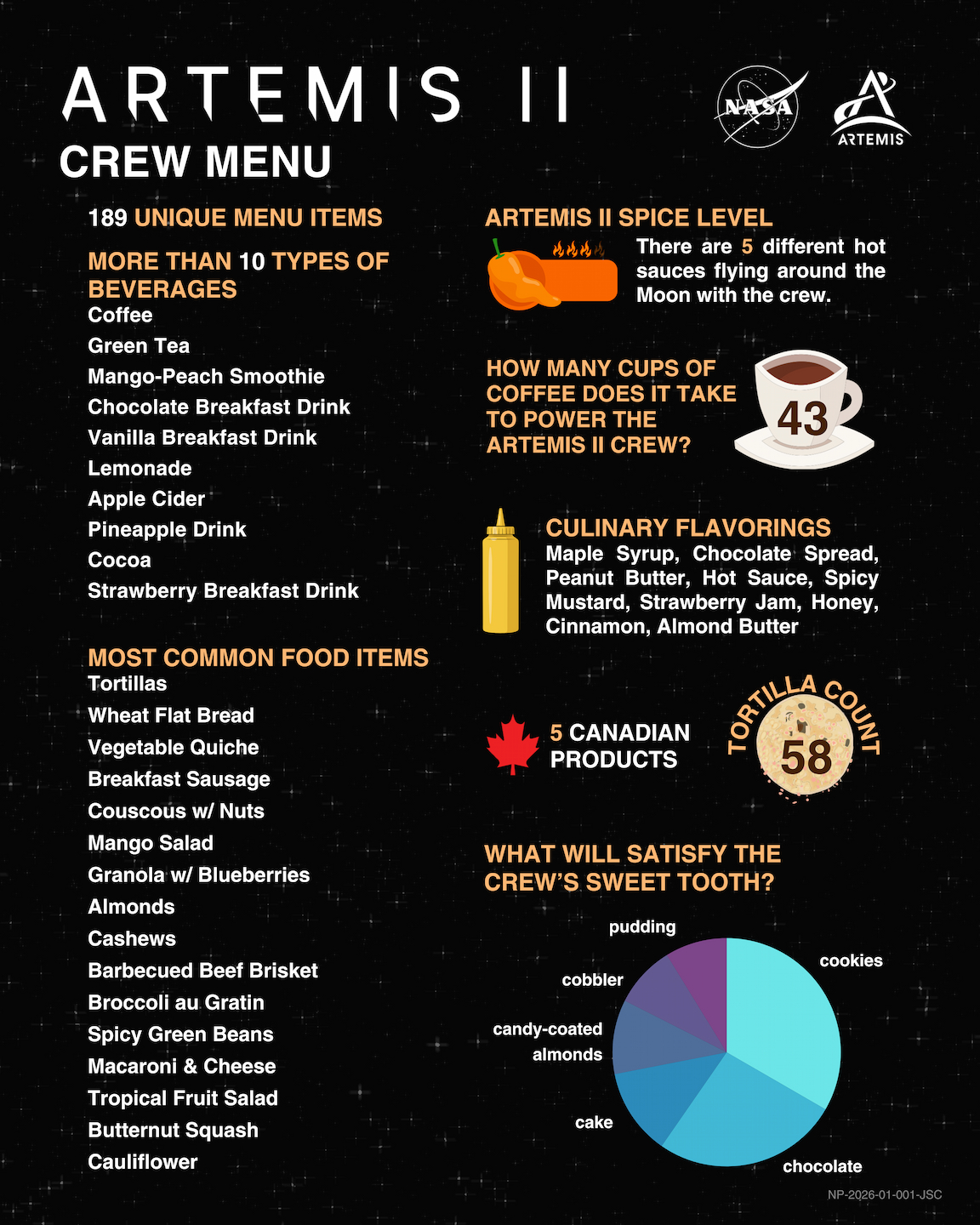
189 unique items and no refrigerator on board
The Orion spacecraft has neither refrigeration nor resupply capabilities, which forced teams to design a diet entirely composed of non-perishable foods for the ten-day mission. Infobae The restriction is no small matter: whatever goes up on the SLS rocket from the Kennedy Space Center next April 1 is all there will be. No orders. No margin for error.
In total, the crew will have 189 unique products at their disposal, with more than 10 types of beverages, five different types of hot sauces, 58 Mexican tortillas, 5 specifically Canadian products, and 43 cups of coffee. Directo al Paladar Canadian Jeremy Hansen, mission specialist and the first non-American to orbit the Moon, has his own reserved.
Among the main dishes, astronauts will be able to choose from beef brisket, macaroni and cheese, vegetable quiche, blueberry granola, scrambled eggs, broccoli au gratin, mango salad, couscous with walnuts, and cauliflower with squash. Functional beverages include coffee, green tea, lemonade, cocoa, and apple cider, plus mango-peach and pineapple smoothies, although the consumption of flavored drinks is limited to two per day due to payload restrictions.
For moments of craving—which are also a nutritional data point, not a whim—the menu includes chocolates, cookies, pudding, cake, cobbler, and candy-coated almonds, all processed using thermostabilization, irradiation, or rehydration methods.
Why crumbs are an engineering problem
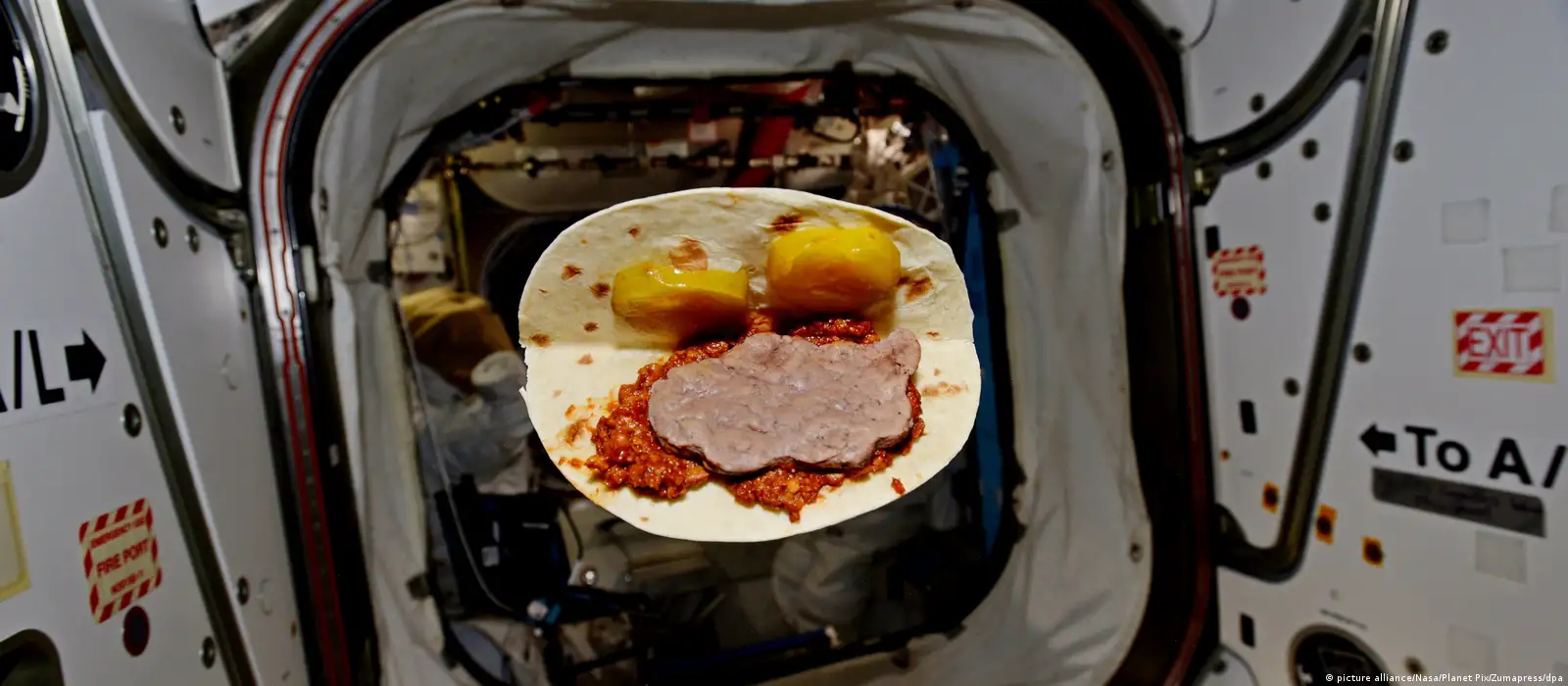
In microgravity, a floating piece of bread is not an anecdote. Crumbs are a real danger because they can get into the crew's eyes or damage the spacecraft's delicate control panels. That's why tortillas are preferred over traditional bread: they shed almost no debris when bitten and are perfectly suited for building combinations during flight.
Meal preparation is intentionally simple, utilizing ready-to-eat, rehydratable, thermostabilized, or irradiated foods that can be prepared safely without interfering with crew operations or spacecraft systems. The spacecraft is equipped with a potable water dispenser and a compact, briefcase-sized heater. There is no stove, there is no microwave, there is no kitchen.
NASA included amaranth as a plant protein on the menu, taking advantage of the nutritional value of this gluten-free pseudocereal, with its high biological value and better protein quality than many conventional foods. A superfood that for centuries was a staple in Mesoamerican civilizations and is now traveling to lunar orbit. The irony has a good texture.
What the palate loses 400,000 kilometers away
In space, taste and smell are attenuated, so meals tend to have more intense flavors and pronounced seasonings. Astronauts will be able to customize their meals with hot sauces, honey, jams, and strong spices, a recurring preference on long-duration missions.
This is no minor detail. The loss of taste sensitivity in microgravity is a phenomenon documented since the first missions: bodily fluids migrate toward the head, causing functional nasal congestion that dulls much of the sensory experience. The solution is the same one that has been working for decades: more spice, more intensity, more coffee.
The space food system has evolved enormously since the early missions. In the Apollo era, astronauts ingested liver paste and meat from tubes, with chocolate sauce for dessert. Today there are 189 options. We still haven't solved gravity, but the menu has improved.
One date, multiple attempts
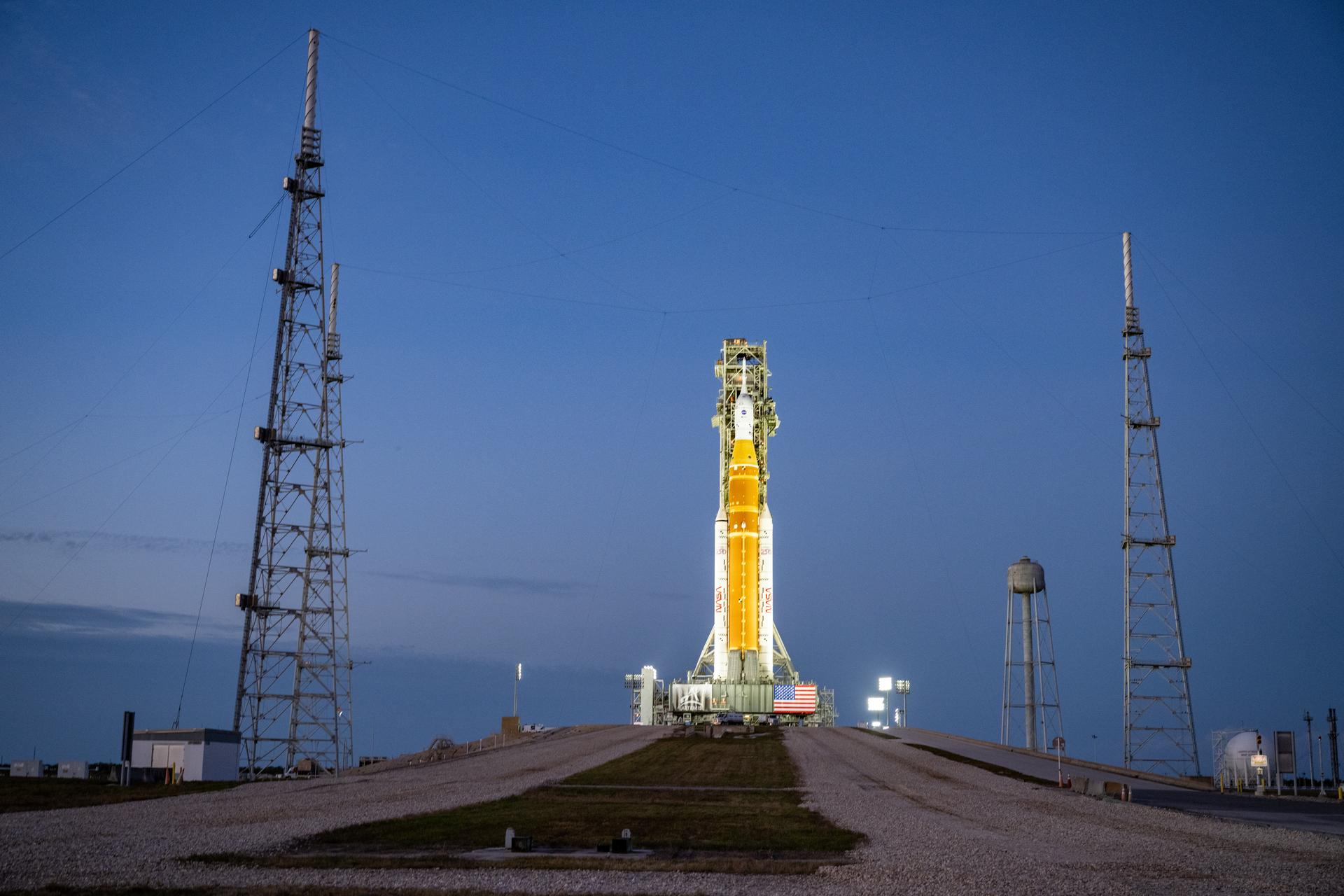
NASA announced that the launch of Artemis II, the first crewed mission to lunar orbit in more than fifty years, is scheduled for April 1 after overcoming a series of technical setbacks. Challenges included a hydrogen leak and a helium flow issue in the upper stage of the SLS rocket.
Engineers attributed the failure to a defective quick-disconnect seal, which was replaced and tested with satisfactory results. Shawn Quinn, exploration ground systems program manager, confirmed that "the solution was implemented on a test article, we've successfully tested it, and qualified it for use on Artemis II."
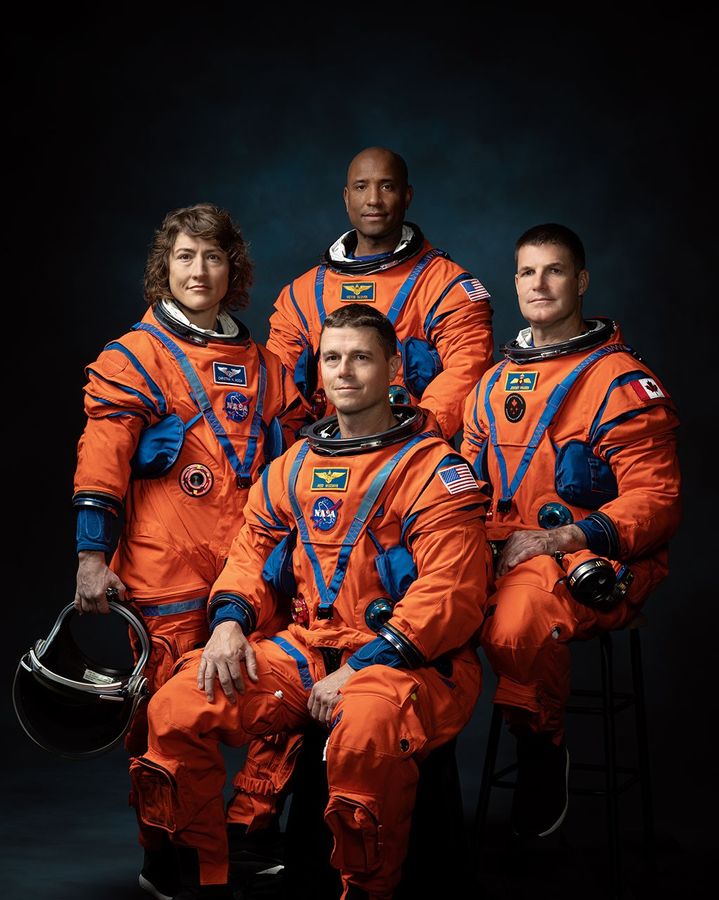
The crew is made up of Reid Wiseman as commander, Christina Koch as mission specialist, Victor Glover as pilot, and Jeremy Hansen representing the Canadian Space Agency. Glover will become the first person of color, Koch the first woman, and Hansen the first non-American to leave Earth orbit and travel around the Moon.
The mission does not include a lunar landing. The astronauts will reach a distance of between 6,450 and 9,650 kilometers above the lunar surface before returning. The central objective is to validate the Orion spacecraft's life support, communications, and navigation systems in real deep-space conditions.
The detail that defines what comes next
Artemis II is not going to step on the Moon. It is going to confirm that the spacecraft can do it later. Every tortilla chosen, every hot sauce packed, every cup of coffee assigned is part of the protocol that will determine if Artemis III can land at the lunar south pole, a region no human has ever set foot in. The last time a person walked on the Moon was in December 1972, during the Apollo 17 mission.
Fifty-three years of pause. And the first major test of the return is decided, among other things, on whether the astronauts eat well for ten days.