TechnologyCulture•6 min read
Pokémon is no longer just about catching creatures. Pokopia asks you to build their home.

Pokémon Pokopia features no battles. It also has no Poké Balls, no random encounters, and no battle screens. On March 5, Nintendo Switch 2 receives its first major flagship title from the best-selling franchise in history, and the premise is as baffling as it is concrete: build the world, and the Pokémon will come on their own.
The game places the player in the shoes of a humanoid-looking Ditto who lands in a devastated ecosystem. Their mission, assigned by Professor Tangrowth, is to restore that world from scratch. There are no rivals to defeat, no gyms, and no promise to catch 'em all. There are ruins, scattered materials, and the task of understanding what kind of habitat each species needs.
That is where the project breaks the mold.
How Pokopia works when there are no Poké Balls to throw
Pokémon are not caught. They are attracted. The player builds biomes, aquatic zones, meadows, and rocky caverns, and the appropriate creatures arrive on their own once the ecosystem is well-designed. Once settled in the territory, they grant the protagonist Ditto elemental abilities that in the original saga exist as combat attacks: Water Gun, Rock Smash, and others yet to be confirmed.
The twist is that these abilities are not used to hurt anyone. They are used for terraforming. Each consumes Power Points and acts upon the terrain itself: flattening areas, opening paths, altering watercourses. The combat mechanic is gone. What remains is an instrumental bond between the player and the creatures: you give them a functional home; they give you the tools to build more.
The world is divided into interconnected zones that unlock as the ecosystem in each region reaches a certain level of biodiversity. The crafting system ranges from basic structures for early habitats to increasingly complex constructions that demand resources from advanced zones. Progression functions as a closed loop: explore to gather, gather to build, build to attract, attract to gain new capabilities.
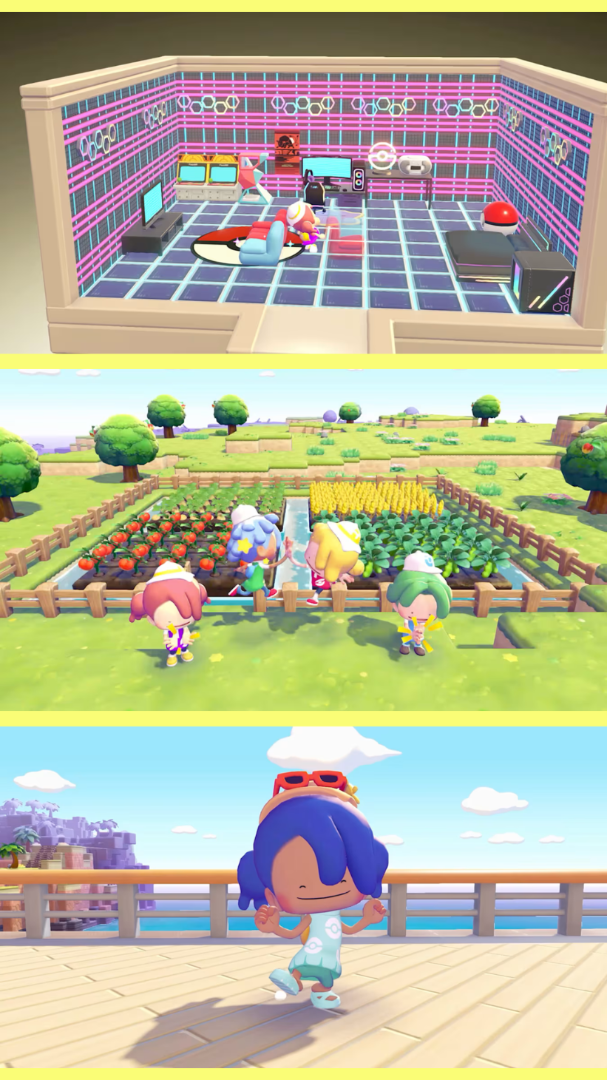
Omega Force, the Koei Tecmo division co-developing the project alongside GAME FREAK, brings the technical solidity its action titles have accumulated over the years, applied here to a design featuring none of those elements. This is the studio behind Hyrule Warriors and Fire Emblem Warriors: they have already shown they can build within other universes without losing cohesion. This is their first foray into the Pokémon universe.
Ditto as the protagonist is no accident
Ditto has been the most unique Pokémon in the catalog for decades: a creature with no true form of its own that only exists by copying others. Choosing it as the protagonist of a game where its identity is built by inheriting the capabilities of others possesses a coherence that borders on narrative self-awareness.
It is not a hero. It is an ecosystem manager with borrowed powers.
And that choice defines the entire premise: a progression model where the player does not dominate the creatures but rather needs them. The difference seems minor. In practice, it radically shifts the relationship between the player and the world, turning environmental restoration into the game's sole true objective.
Nintendo Switch 2, Game Share, and the first major shared license experiment
Pokopia debuts as one of the first heavyweight titles for Nintendo Switch 2 and embraces one of the most discussed features of the new hardware: Game Share, the shared license system that allows additional players to join a session without purchasing their own copy. The console hit the market as Nintendo's most highly anticipated successor in years, and for Pokémon to occupy that space with a format experiment indicates the kind of bet Nintendo wanted to make with its early adopters: not the usual game, but one that justifies buying the console for novel reasons.
The title requires 10 gigabytes of local storage and arrives on physical cards containing an embedded digital code, lacking a traditional data cartridge. The change impacts the second-hand market and the culture of physical lending among friends, though Game Share absorbs part of that blow by guaranteeing cooperative access without an individual license. For Nintendo, the feature is also a hardware selling point: the barrier to entry drops when a user without the game can jump in if someone with a license is nearby.
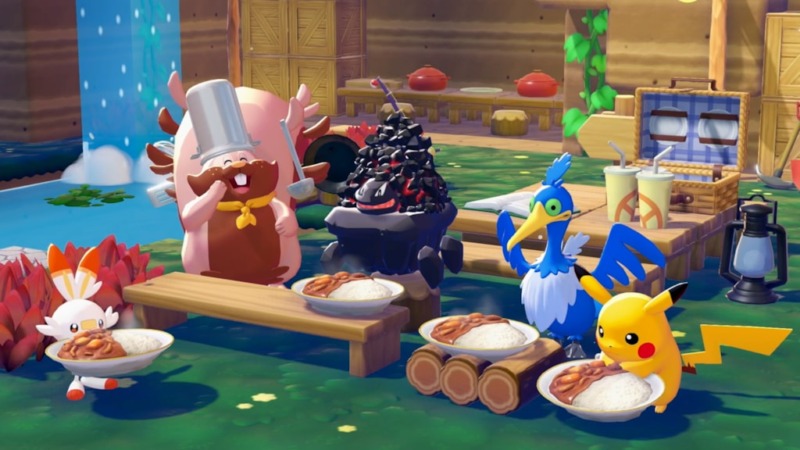
The multiplayer layer includes culinary mini-games led by Chef Greedent, a character designed to anchor the social dimension within the core loop. His presence positions Pokopia within the tranquil social simulation sub-genre, the same space Animal Crossing or Stardew Valley occupy, with all the commercial intent that implies.
Animal Crossing: New Horizons sold more than 45 million units. Nintendo is not building upon that figure by accident.
What Pokopia says out loud and what it prefers not to mention
GAME FREAK has spent years accumulating criticism for the technical state and limited ambition of its mainline entries. Scarlet and Violet arrived with visible stability issues on a console already showing its ceiling. The studio's response was not to reinforce the main formula.
It was to delegate to Koei Tecmo and build something outside of it.
Pokopia does not answer those criticisms. It dodges them. And it has its own merit: instead of trying to patch up what doesn't work under pressure, they opted to create a parallel line with fewer expectations and more freedom to experiment. If Pokopia works, it expands the universe. If not, the risk is absorbed by a spin-off experiment. It's a defensively smart move, which does not necessarily make it a brave one.
We are still waiting for the game that proves the main saga can reinvent itself without needing a new console launch as an excuse and an external studio as a crutch. What Pokopia has to offer is real. It just doesn't answer the question that has been pending for years.
March 5 is the launch date. What we still don't know is whether Pokopia marks the beginning of something or simply proves that even the most profitable franchise on the planet needs, from time to time, to step off the turf it built itself.
Sources
The most important news while you enjoy a cup of coffee.
Join our community. Get our exclusive weekly analysis before anyone else.
Related News

Cultura
7 min read
86 years old, it was the 'final level' of Chuck Norris: Farewell to the action cinema legend
The actor, world karate champion and internet phenomenon passed away on March 19 after a medical emergency in Kauai. His last post was a video training on his birthday.

GlobalCultura
6 min read
World Water Day 2026: women and 200 million hours of water inequality
Every day, women and girls worldwide spend the equivalent of 23,000 human years carrying water. World Water Day 2026 repeats it. The question is how many more times it needs to be said.

TecnologíaGlobal
5 min read
NASA confirms the date and menu for Artemis II
The Orion spacecraft has no refrigerator or resupply. That's why NASA designed 189 unique items, amaranth as protein, five types of hot sauce, and 43 cups of coffee for 10 days around the Moon.


