Six days of war in the Middle East: Trump wants to choose Iran's next leader
Donald Trump declared to the press that Mojtaba Khamenei, the late ayatollah's son, is an "unacceptable" choice as successor and that the United States must have a voice in choosing the Islamic Republic's next supreme leader. It is not a metaphor. It is literally what the president of a country that has been bombing another for six days said.
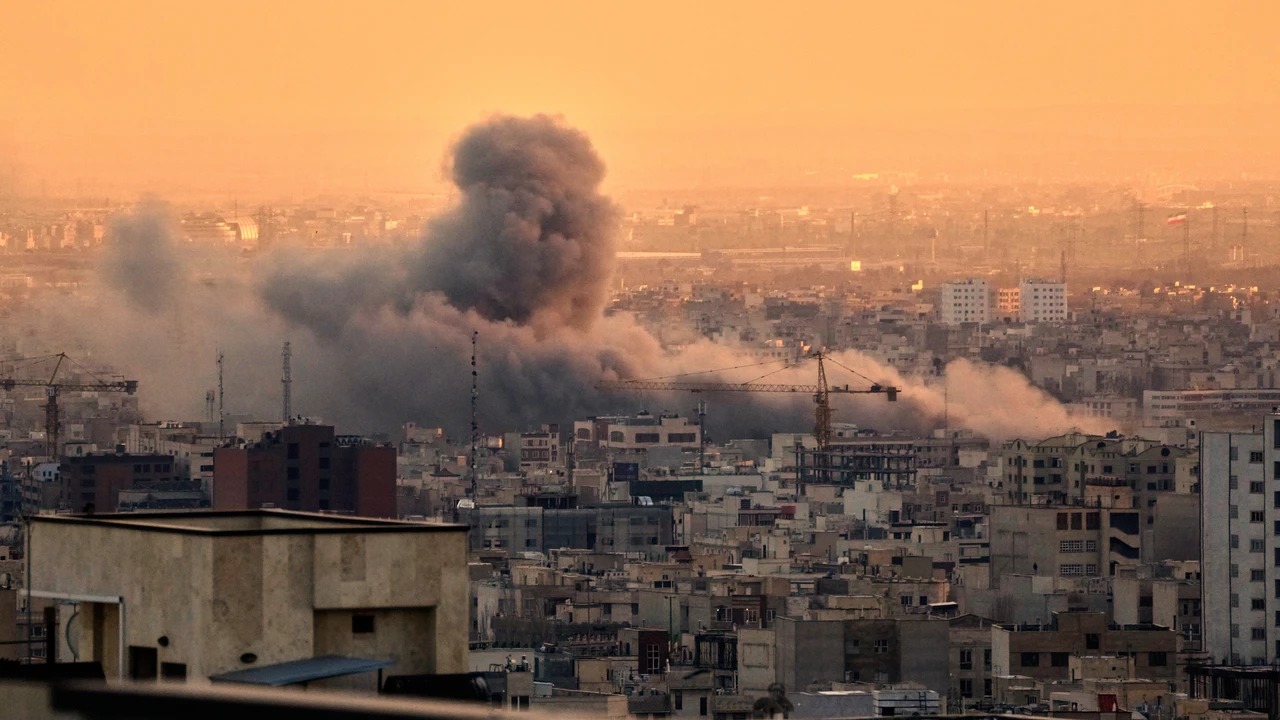
This morning's tally: at least 1,230 dead in Iran since February 28, Israel ordered the evacuation of all southern suburbs of Beirut, hundreds of thousands of people, the Emirates intercepted 131 drones and six ballistic missiles in a single day, and the Strait of Hormuz remains effectively closed to maritime traffic. Twenty million barrels of oil per day with no route out.
The world hasn't collapsed yet. But the price of gasoline in the United States registered its largest single-day jump this Thursday since Hurricane Katrina in 2005.
Why the Strait of Hormuz changes the whole equation
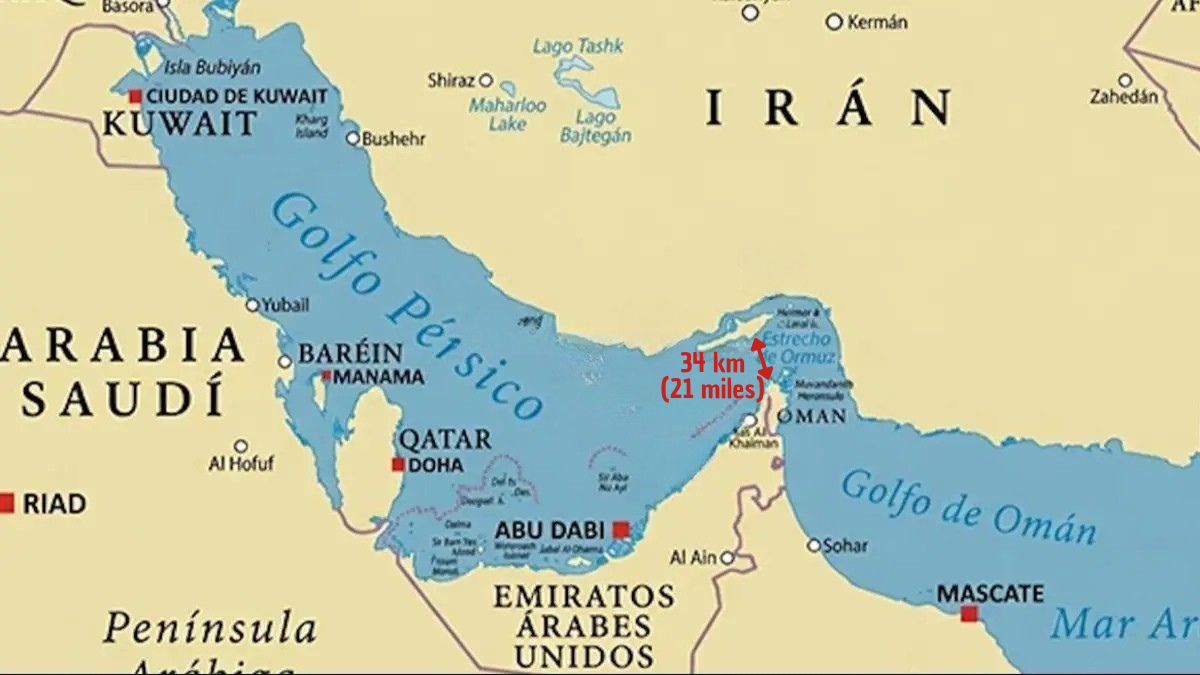
There is a 34-kilometer-wide corridor located between Iran and Oman through which 20% of the world's oil transits. The Revolutionary Guard declared it closed. General Ebrahim Jabari was explicit: "The strait is closed. If anyone tries to pass, the heroes of the Revolutionary Guard and the regular navy will set those ships on fire."
Satellite tracking data shows a 70% drop in tanker traffic, with more than 150 vessels anchored in open Gulf waters waiting for the situation to clear. The world's top shipping companies suspended operations. Maritime insurers canceled war risk coverage. According to S&P Global Energy, only five oil tankers transited the Strait of Hormuz on Sunday, a figure vastly below the recent average of 60 vessels per day.
The structural problem is that there is no viable alternative. Middle Eastern producers can hold out for no more than twenty-five days before storage saturation forces them to halt activity. Saudi Arabia, Kuwait, Qatar, Iraq, and the Emirates export via this route. Without it, the global energy chain simply has no other path.
The International Maritime Organization reported that some 20,000 sailors and 15,000 cruise ship passengers are stranded in the Persian Gulf. They are people trapped in the middle of a war they didn't choose, in a sea that suddenly stopped being safe for anyone.
The succession nobody controls, and Trump wants to control
Israel bombed the Iranian Assembly of Experts on Tuesday while its members were holding an emergency session to select a new supreme leader. The message was as direct as a missile: the Israeli government publicly declared that any successor would be an "unequivocal target for elimination."
Trump went further, declaring to the media that Mojtaba Khamenei, son of the deceased leader, is "unacceptable" as a successor, and that the United States must participate in the election of Iran's future leader. The Senate, meanwhile, rejected a Democratic resolution to limit the president's war powers: the vote was 47 to 53 against halting military operations.
That means Trump has the legislative green light to continue. And that nobody, for the moment, has an institutional mechanism to stop him.
Russia, Tehran's great historical ally, chose a stance this Thursday that says it all. Kremlin spokesman Dmitry Peskov stated that Moscow will prioritize its own economic interests and that "it's not our war," while Kremlin analysts calculated how to benefit from the rising oil prices the blockade generates. Khamenei's assassination highlighted something Moscow preferred not to admit: Russian influence in the Middle East has been more rhetorical than real for some time.
The front widens: Azerbaijan, the Kurds, and a NATO that fires back
The war crossed borders nobody had included in the initial maps. An Iranian-made drone struck the airport terminal in the autonomous region of Nakhchivan, Azerbaijan, and another fell near a school in the town of Shekarabad, injuring two civilians. Baku demanded formal explanations from Tehran on an "urgent" deadline.
In northwestern Iran, Kurdish-Iranian armed groups launched a ground offensive against the Islamic government. U.S. sources reportedly asked Iraqi Kurds for assistance in cross-border military operations, and Kurdish forces in northern Iraq are on alert to join the conflict.
NATO air defense systems shot down an Iranian missile heading toward Turkish airspace. It is the first time since the conflict began that the Atlantic Alliance has directly intercepted an Iranian projectile over the territory of a member state. France authorized U.S. armed forces to use French military bases, the United Kingdom allowed the use of its bases for defensive purposes, and Canadian Prime Minister Mark Carney could not rule out Canada's participation in the conflict.
Spain remains the visible exception: Pedro Sánchez maintains his refusal to allow national bases to be used for offensive operations. U.S. diplomatic sources claim to have obtained guarantees of logistical cooperation from Madrid following direct pressure from the Trump administration. The usual geometry of Atlanticism.
What official statements don't say about Iran
Inside the country, the situation for the civilian population is one of almost total informational isolation. Internet access is blocked, state media claims Iran is winning the war, and banks have restricted cash withdrawals. Electricity, water, and gas supplies remain intact, though food prices, already soaring, continue to rise.
General Dan Caine, Chairman of the Joint Chiefs of Staff, reported that the volume of Iranian launches dropped 86% for missiles and 73% for drones compared to the first day. The official reading is that coalition defenses are working. The alternative reading, which nobody at the Pentagon utters out loud, is that Iran is being decimated in its response capability at a speed that makes it difficult to distinguish tactical victory from exhaustion.
Pete Hegseth declared at the Pentagon that "America is winning" and that the operation is still very early: "the metrics are shifting, the dust is settling, and more forces are arriving." Six days of war. More than 1,200 confirmed dead. A tenth wave of bombings over Tehran. And the Secretary of Defense saying this is just the beginning.
The map of consequences that is no longer hypothetical
China, the world's largest crude importer, relies on the Strait of Hormuz for about 40% of its oil and depends on Qatar and the Emirates for roughly 30% of its liquefied natural gas. Beijing remains publicly silent. But its strategic reserves have an expiration date.
India faces a double blow: more than half of its liquefied gas imports are priced against Brent crude, which means the Hormuz bottleneck simultaneously raises the cost of oil and gas. For Pakistan and Bangladesh, with minimal storage capacity, analysts project direct blackouts before a spot market dispute even takes shape.
The Iranian spokesperson warned this week that the global economy will face a serious crisis if the situation is not resolved in three weeks. That's fourteen days from today.
The question no government has publicly answered is the exact condition under which this war ends. Trump talks about "four or five weeks." Hegseth says they are "winning." Israel promises to eliminate any successor Iran designates. And the Strait of Hormuz, that 34-kilometer channel through which a fifth of the planet's oil flows, hasn't seen normal traffic for days.
Twenty-five days, according to analysts, is the margin before storage saturation forces a partial production shutdown in the Gulf. The clock has been ticking since the first bombing.