Technology•5 min read
Resident Evil Requiem is the highest-rated game of the year. The first controversial review was written by an AI with a fake name

Thirty years after a government missile wiped Raccoon City off the map, Capcom has returned to the scene. The story of Resident Evil Requiem takes place in October 2026, exactly 28 years after the destruction of the fictional city portrayed in 1999's Resident Evil 3: Nemesis, and opens with Grace Ashcroft, an FBI analyst with the profile of a compulsive introvert, receiving orders to investigate a string of deaths in an abandoned Midwest hotel. The same hotel where her mother was murdered eight years earlier. Capcom hasn't been doing this for three decades by accident.

With over 100 reviews on PlayStation 5, Resident Evil Requiem concluded its embargo with an 89 Metascore, the highest score for a numbered, non-remake installment since 2005's Resident Evil 4. To put the scale in perspective: in the franchise's recent history, that bar has only been surpassed by the Resident Evil 2 remake in 2019 and the RE4 remake in 2023. The original game, the one that inaugurated the modern formula, hadn't been matched by a built-from-scratch installment in over twenty years. On Xbox, the score reached 92, 91 on PC, and 90 on Switch 2, with an aggregated average Metascore of 90, placing it in the realm of universal acclaim. Game Rant gave it a 100. IGN, a 90. TechRadar, more skeptical, settled at 80, pointing out that the second half of the game gives in to fan service. Critics are unanimous on the fundamentals and divided on the details.
The game is the first in the series developed exclusively for ninth-generation consoles, built from the ground up with ray tracing in mind, and on PC it implements full path tracing with multi-bounce global illumination, reflections, shadows, and ray-traced ambient occlusion. Put more directly: it's the game that finally justifies having an expensive graphics card. The dual-perspective system, which allows switching natively between first and third person, translates into two sensorially distinct horror experiences on the same stage. Grace Ashcroft has stealth and survival sections with scarce resources, where she can crouch, hide under tables, and use glass bottles to distract a monster chasing her through walls and ceilings. Leon S. Kennedy operates in action mode, with an ax, parries, and enemy weapons. Two games within the same title. The bet is obvious. And according to critics, it works.
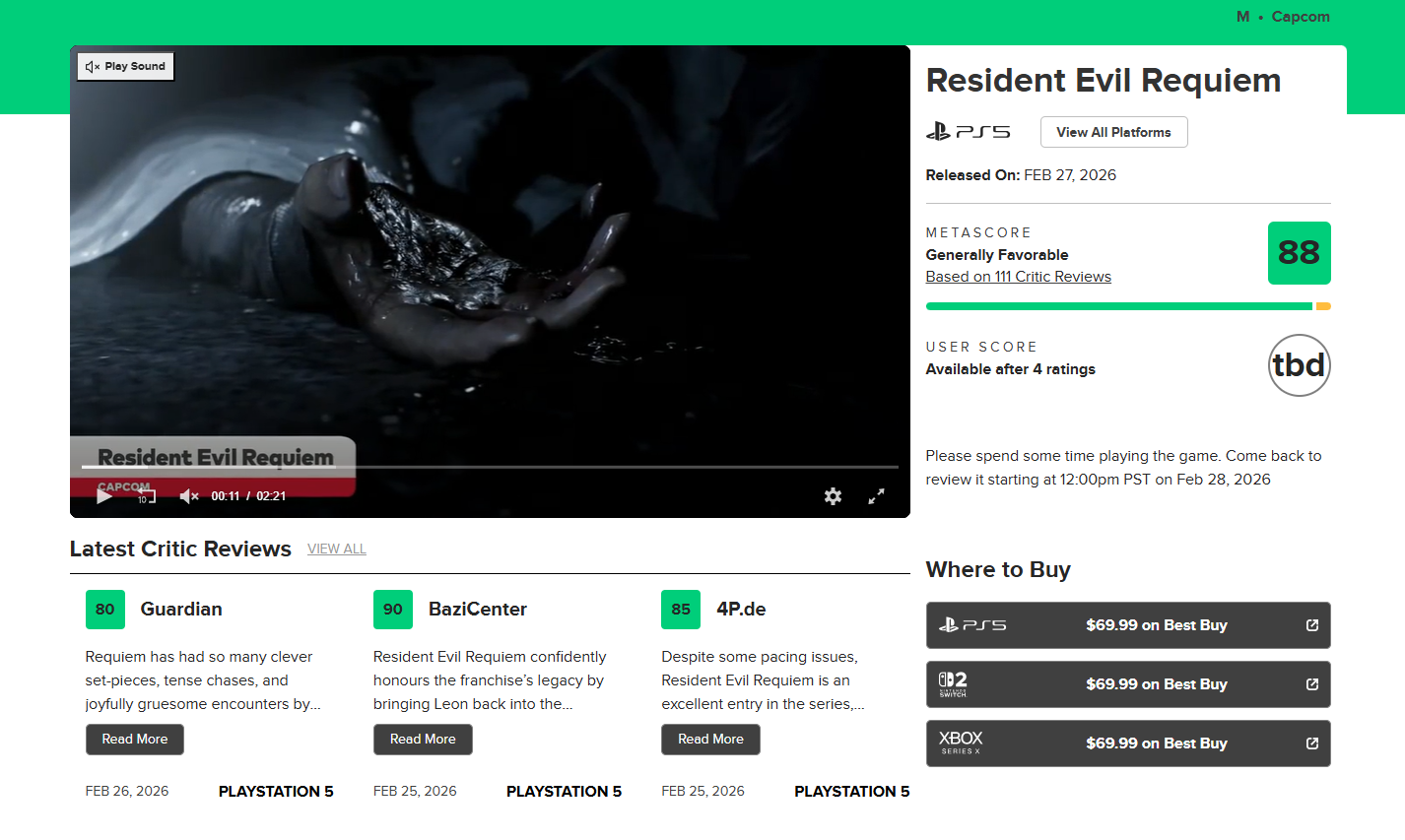
In early January, Capcom announced that the game had surpassed 4 million wishlists across platforms. The hype wasn't abstract; it was measurable. If the game sells at least one million copies, it will be the 36th release in the Resident Evil franchise since 1996 to surpass that figure. The saga hasn't dropped below that threshold even in its worst times. Raccoon City remains an excellent business.
The price margin in the European digital market tells its own story. In Spain, physical editions debuted at 54.99 euros. On key distribution platforms, prices ranged from 25.70 euros on gray markets to 46.49 euros on official portals like Instant Gaming. A gap of nearly 30 euros for the same digital product. The parallel ecosystem of activation keys has existed in a legal limbo for years, and every release of this magnitude makes it more visible. Capcom has not commented.
Now then. Launch day also produced a parallel news story, more revealing than any score on an aggregator.
VideoGamer, a British outlet founded in 2004 and recently acquired by Clickout Media, an SEO agency specializing in betting and casinos, published a review of Resident Evil Requiem signed by "Brian Merrygold," described as an "experienced iGaming and sports betting analyst." Readers pointed out that the text "reeked of AI," and that Merrygold seemed to be a fabricated person with a profile picture generated by ChatGPT. It wasn't hard to verify: when attempting to save the profile image locally, the file name was "ChatGPT-Image-Oct-20-2025-11_57_34-AM-300x300.png". Nobody bothered to change it.

The review's score, a 9 out of 10, was indexed by Metacritic alongside over a hundred reviews presumably written by flesh-and-blood people. Marc Doyle, co-founder of Metacritic, confirmed the removal of the review and several other VideoGamer reviews published in 2026. The aggregator issued an internal policy note to all covered outlets: "Our policy is to never include an AI-generated review on Metacritic, and if we subsequently discover one has been published, we will remove it immediately and sever ties with that publication."
The irony of the situation deserves a second's pause. The year's highest-rated game on Metacritic, the one that built the most anticipation on wishlists, the one human critics welcomed with their best analytical tools, was also the first to serve as a vector for the most visible contamination of the industry's largest review aggregator. Sources consulted by Kotaku indicate that Clickout began publishing AI-generated content in the site's casino and betting sections last fall, but it wasn't until the firing of the entire editorial staff last week that AI content began invading video game news, reviews, and features. The site's fifteen-year history of human bylines were replaced by similar-looking profiles.
Thirty years of Resident Evil have produced thirty-five million-selling releases, several genre reinventions, two periods of bloodthirsty criticism, and a return in the form of a remake that rejuvenated the franchise. What it hadn't produced until now was a release that, on its premiere day, simultaneously starred in the saga's greatest critical praise in two decades and the sector's most flagrant episode of journalistic fraud of the year. Capcom is not to blame for either. But the combination says something about the state of video game journalism that no Metacritic score is going to solve.
The game is good. That's clear. What remains unresolved is who is saying it.
Sources
- Kotaku – RE Requiem Best-Reviewed Main Entry in Over 20 Years
- Kotaku – Metacritic Removes AI Review
- Windows Central – Reviews and Metacritic Scores
- Wikipedia – Resident Evil Requiem
- AV Club – Metacritic drops VideoGamer AI review
- PC Gamer – AI-generated review briefly hit Metacritic
- Metacritic – Resident Evil Requiem
The most important news while you enjoy a cup of coffee.
Join our community. Get our exclusive weekly analysis before anyone else.
Related News

TecnologíaGlobal
5 min read
NASA confirms the date and menu for Artemis II
The Orion spacecraft has no refrigerator or resupply. That's why NASA designed 189 unique items, amaranth as protein, five types of hot sauce, and 43 cups of coffee for 10 days around the Moon.

TecnologíaDinero
5 min read
Meta lays off 16,000 people. Its stock rises 3%
Reuters confirmed plans to cut up to 20% of Meta's workforce. Wall Street celebrated the news with a 3% surge. In 2026, AI already justifies 55,775 layoffs in the tech sector.

Tecnología
6 min read
AI already solves centuries-old math. What your bank encrypts is being rebuilt from scratch.
AlphaEvolve surpassed any known human solution in 20% of 67 open mathematical problems. At the same time, the RSA encryption that protects banks and government networks has been in the process of replacement for months. Two converging transformations.


