Technology•6 min read
AI already solves centuries-old math. What your bank encrypts is being rebuilt from scratch.

A machine designed by Google DeepMind reviewed 67 unsolved mathematical problems and, in one out of every five, produced a better solution than any known human result to date. Not as an approximation. As a verifiable, formalizable, publishable discovery.
That system is called AlphaEvolve. And what it did with pure mathematics is the prelude to something broader: the cryptographic architecture that protects banks, postal services, and government networks has been undergoing a ground-up reconstruction for months, for reasons directly linked to quantum computing. Two parallel transformations, each large enough to warrant its own coverage. Together, they redefine the relationship between the algorithm and the human mind.
AlphaEvolve: when AI stops assisting and starts discovering
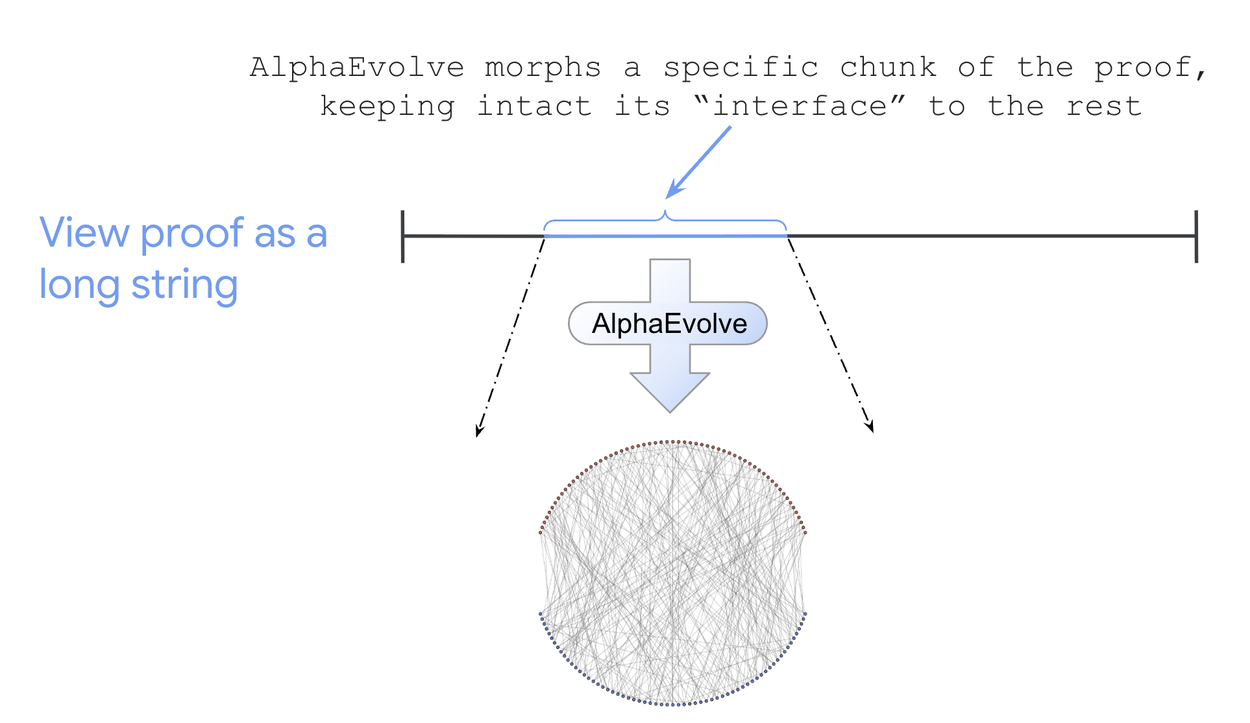
AlphaEvolve is not a chatbot that solves exercises. It is an evolutionary agent that combines Google's Gemini models to generate code, evaluate it, discard what doesn't work, and refine what does, in successive iterations on the same problem. The result is not a probable answer: it is a computer-verifiable algorithm.
The system operates as a "general-purpose evolutionary code agent," using language models to iteratively propose, test, and refine solutions. In collaboration with Fields Medal-winning mathematician Terence Tao, and a team that includes Spanish mathematicians Javier Gómez Serrano and Gonzalo Cao Labora, DeepMind evaluated AlphaEvolve on 67 problems from various branches: analysis, combinatorics, geometry. In 75% of the cases, the system replicated the optimal known solution. In 20%, it surpassed it with a new solution.
Matej Balog, the DeepMind researcher who led the project, was blunt about it: "Each of those cases is a new discovery."
Among the concrete findings: AlphaEvolve raised the lower bound of the kissing number in eleven dimensions from 592 to 593, a spherical geometry problem that had been stalled for decades. It also developed a more general version of the 4x4 matrix multiplication algorithm, the operation that underlies practically all of modern machine learning. It also devised a heuristic to optimize task allocation in Google's data centers, a system that has been in production for over a year and reclaims 0.7% of the company's global computing power.
What changes is not just the speed. It's who asks the questions.
If traditional mathematics is based on logical deduction, AlphaEvolve introduces massive statistical induction to detect probabilities and explore territories previously inaccessible to human researchers. The system does not work alone: it requires a non-trivial amount of human effort to design the verifiers and guide the system, so researchers position it not as a replacement for the mathematician, but as a new kind of research collaborator.
The silent reconversion of global encryption
While AlphaEvolve demonstrates that AI can formulate and solve pure mathematical research problems, another mathematical discipline is going through its own crisis: cryptography.
RSA and elliptic curve-based systems, the pillars of current encryption, rest on an assumption: that factoring numbers hundreds of digits long is computationally unfeasible. For a classical computer, it is. For a quantum computer with enough power, Shor's algorithm solves that exact problem in practical timeframes, leaving vulnerable encryptions that today would take millions of years to break, and putting global digital security at risk. "Q-Day", the theoretical date when that becomes possible, is estimated to be ten to fifteen years away.
But data encrypted today can be intercepted now and decrypted later. The threat, known as "harvest now, decrypt later," allows attackers to collect encrypted data today with the intention of decrypting it when quantum resources allow. The threat doesn't wait.
In August 2024, NIST published the final version of the first standards for quantum-resistant cryptography: FIPS 203, based on Kyber for key exchange; FIPS 204, based on Dilithium for digital signatures; and FIPS 205, based on SPHINCS+ for hash-based signatures. Eight years of global evaluation, distilled into three federal standards that now become a de facto requirement for governments and the financial sector worldwide.
Companies like Amazon and Google have already begun integrating these standards into their cloud infrastructure to offer their customers a secure quantum environment. The financial sector faces what specialists call "crypto-agility": inventorying all their cryptographic assets, classifying them by risk, and migrating in stages without interrupting critical operations. It is the quietest and most expensive transition in recent digital security history.
The structural irony of this moment is that the same mathematical advances AlphaEvolve helps formulate—lattice problems, combinatorics, discrete geometry—are the theoretical basis of the new quantum-resistant algorithms. The AI that conquers pure mathematics and the quantum computing that threatens classical cryptography drink from the same well. Different currents of the same river.
The third actor: the mathematician with a mitre
On March 14, International Day of Mathematics and the date when the world celebrates the number π, Pope Leo XIV sent a message to the global scientific community.
This is no minor detail. Robert Francis Prevost graduated in Mathematics in 1977 from Villanova University, an education that preceded his formal entry into the Augustinian novitiate and his theological studies. During his time in Chicago, he combined religious training with teaching, instructing mathematics part-time at Mendel Catholic High School. He is the first pope with formal mathematical training in the recent history of the Church.

The message, addressed to Professor Betül Tanbay, president of the International Day of Mathematics, was transmitted on behalf of the Pontiff by Vatican Secretary of State Cardinal Pietro Parolin. The theme of the webinar to which he was convened: "Mathematics and Hope".
The Pope's focus: pointing out that "a particularly fruitful field of research is the use of algorithms, especially in the field of artificial intelligence," though emphasizing that this task demands "not only intellectual effort and ingenuity, but also an integral growth of the whole person" capable of addressing the moral dimension of emerging technologies.
A mathematician pope, sending a message to mathematicians about artificial intelligence, on the same day machines prove they can do better mathematics than humans. If irony had a sense of timing, it couldn't have planned it better.
The scale that doesn't make headlines
The global AI agents market was valued at $5.9 billion in 2024 and is projected to grow to $105.6 billion by 2034, with a compound annual growth rate of 38.5%. These are figures published weekly that no one reads with astonishment anymore. They have become as routine as air traffic reports.
What those numbers fail to capture is the qualitative shift. AlphaEvolve does not automate repetitive tasks: it formulates verifiable mathematical hypotheses. The new NIST post-quantum standards do not update a protocol: they rebuild the contract of trust upon which the internet operates. And a pope with a math degree warns, with technical precision few expected from a pontifical message, that the problem is not the algorithm but the person deciding what to ask of it.
We keep calling all this "progress" or "advances." The question no NIST standard can answer is when we decide that some problems are too important to entrust to a system that, in the remaining 5% of cases, produces worse results than humans without anyone noticing in time.
Sources
The most important news while you enjoy a cup of coffee.
Join our community. Get our exclusive weekly analysis before anyone else.
Related News

TecnologíaGlobal
5 min read
NASA confirms the date and menu for Artemis II
The Orion spacecraft has no refrigerator or resupply. That's why NASA designed 189 unique items, amaranth as protein, five types of hot sauce, and 43 cups of coffee for 10 days around the Moon.

TecnologíaDinero
5 min read
Meta lays off 16,000 people. Its stock rises 3%
Reuters confirmed plans to cut up to 20% of Meta's workforce. Wall Street celebrated the news with a 3% surge. In 2026, AI already justifies 55,775 layoffs in the tech sector.

Tecnología
5 min read
The secret to longevity? The Greenland shark holds some clues in its DNA
Researchers sequenced the most complete genome of the longest-living vertebrate on the planet and found 81 duplicated DNA repair genes that do not exist in this way in any other known species.


