A telescope retired in 2018 just produced the most significant find in the search for habitable worlds in the last decade. The data Kepler collected during its extended K2 mission, archived and forgotten for years, contains the signature of a rocky planet 146 light-years away orbiting a Sun-like star in exactly 355 days. It is called HD 137010 b. And for now, it is the closest candidate to a cold Earth that astronomers have seen crossing the face of a solar-type star.
HD 137010 b: the strongest candidate in years, with an important caveat
On January 29, 2026, an international team of astronomers announced the discovery of HD 137010 b, returning NASA to the center of exoplanet exploration. The planet was detected using data from the Kepler telescope during its extended K2 mission.
The find came from a transit lasting approximately 10 hours, compared to the 13 hours Earth takes to cross the solar disk from our perspective. That detail allowed scientists to estimate the planet's size: just 6% larger than Earth, with an orbital period very close to the terrestrial year, around 355 days.
What sets it apart from most previous discoveries is the star it orbits. Prior discoveries of Earth-sized planets in habitable zones have occurred mainly around red dwarfs, which are much smaller and dimmer than our Sun, with the risk that such planets lose their atmospheres to high-energy radiation. In contrast, HD 137010 b's host star has properties much closer to those of the Sun, which increases the likelihood that the planet could sustain a stable atmosphere.
Here comes the caveat that headlines tend to bury.
The amount of heat and light the planet receives from its star is less than one-third of what Earth receives from the Sun. That could mean a surface temperature no higher than -68 degrees Celsius, comparable to Mars's average temperature. Not exactly a resort. But not irrelevant either: beneath thick layers of ice, liquid water may exist, and in that water there may be something more.
The study notes that there is roughly a 50% probability that HD 137010 b falls within its star's habitable zone, though at its coldest end. This finding broadens the classical definition of habitability and raises questions about how far a frozen planet might still harbor favorable conditions.
There is another minor issue that researchers address with honesty: the discovery comes from a single transit, just one instance of the planet crossing its star's face. Scientists need that transit to repeat regularly to confirm this is a real planet and not an error or a one-off event. Technically it remains a "candidate." But it is a candidate everyone is talking about.
Why 146 light-years matters more than 490
Distance is not a cosmetic detail. At 146 light-years, HD 137010 b is much closer than other potentially habitable exoplanets like Kepler-186f, located more than 490 light-years away, making it an ideal candidate for future direct observation missions.
In practical terms, it means the James Webb Space Telescope could analyze the composition of its atmosphere through transmission spectroscopy: the process in which starlight passes through the planet's gaseous layer and reveals, via its chemical fingerprints, what lies within. Oxygen. Methane. Water vapor. The molecules that, in any unexpected combination, would make the entire world stop what it was doing.
For now, we are still waiting for the second transit detection. But the data archive of a retired telescope has already done its part.
| Exoplanet | Distance (Light-Years) | Earth Similarity | Habitability Status |
|---|
| Proxima Centauri b | 4.2 ly | 1.07 Earth radii | Habitable zone (Red dwarf) |
| Teegarden b | 12.5 ly | 1.05 Earth radii | Very high (95% ESI) |
| TRAPPIST-1 e | 39.5 ly | 0.91 Earth radii | Habitable zone (Multi-planet system) |
| HD 137010 b | 146 ly | 1.06 Earth radii | Edge of habitable zone |
| Kepler-452 b | 1,400 ly | 1.63 Earth radii | Earth's "older cousin" |
- ESI = Earth Similarity Index; higher values indicate greater similarity to Earth but do not guarantee habitability.
- Distances and radii are approximate and depend on measurements that may be updated with new observations.
- "Habitable zone" here refers to the region around a star where liquid water could exist on the surface, but true habitability depends on atmosphere, composition, and stellar activity.
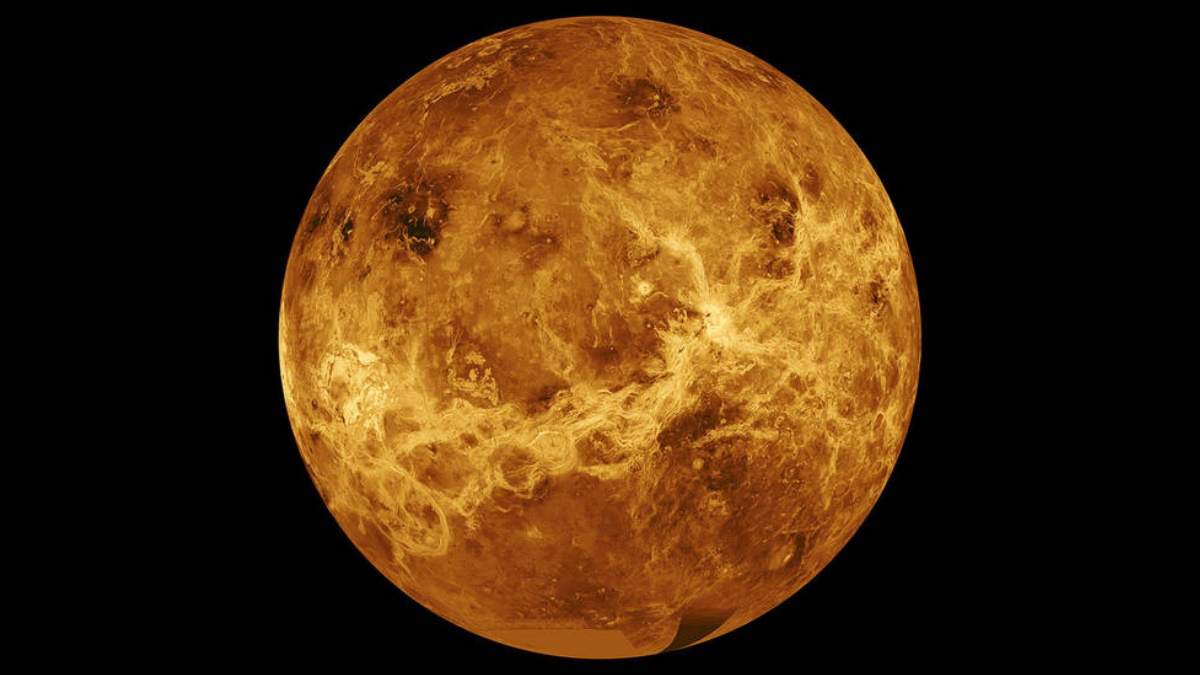
Venus: the solar system's largest cave had been sitting in an archive for 30 years
While astronomers debate a world 146 light-years away, the nearest planet just revealed something no one expected to find so close to home.
A team of Italian scientists confirmed the existence of an underground volcanic cavern on Venus in a study published on February 9, 2026, in the journal Nature Communications, following a reanalysis of radar data obtained by NASA's Magellan mission in the 1990s.
The results indicate a lava tube nearly one kilometer in diameter, with a ceiling at least 150 meters thick and an internal void no less than 375 meters deep. And that is only the portion that the current data allows to be measured with confidence. Analysis of the terrain's morphology and the presence of other similar pits supports the hypothesis that underground conduits may extend at least 45 kilometers.
The data was 30 years old. It had been sitting there in the archives. No one had read it with the right techniques.
The structure is located on the western flank of Nyx Mons, a shield volcano 362 kilometers in diameter. Scientists detected a pit on the surface: the unmistakable signal of a collapsed ceiling. Below it, a hollow tunnel formed by solidified lava. The same phenomenon that produces volcanic caves in Lanzarote, but at a scale that makes Lanzarote's caves look like a garage.
Lorenzo Bruzzone, a researcher at the University of Trento and coordinator of the project, explained that knowledge of Venus remains limited and that until now they had never had the opportunity to directly observe processes beneath its surface.
The finding does not make Venus a candidate for life: its 465-degree surface temperature and clouds of sulfuric acid take care of disabling that narrative. But it does demonstrate that the most overlooked planet in the solar system has a far more complex interior geology than models had suggested. The upcoming ESA EnVision and NASA VERITAS missions, planned for this decade, will continue this work with radars capable of probing the subsurface at greater depth and resolution.
Mexico in Antarctica: 50 kilos of samples and 145 million years of history
While the international scientific community processes these discoveries, Mexico quietly completed its first chapter in polar science.
UNAM concluded the First Mexican Antarctic Campaign with the collection of 50 kilograms of physical-chemical samples, rocks and sediment cores, with which researchers will investigate what the planet's configuration looked like 145 million years ago and the links between the marine environment, glaciers, and global climate.
The expedition was multidisciplinary in nature, covering research in climate change, biodiversity, oceanography, stratospheric science, and extreme microbiology. The team worked from Ukraine's Akademik Vernadsky Antarctic Station and aboard the icebreaker Noosfera, under a cooperation agreement signed in August 2025.
Researchers noted that what happens in Antarctica, though seemingly remote, has direct effects on Mexico: rising sea levels threaten coastal cities like Cancún, Veracruz, and Mazatlán, and changes in ocean temperature affect the sardine, tuna, and shrimp fishing industries that are fundamental to the country's coastal economies.
Antarctic ice preserves air bubbles containing atmospheric data going back up to 800,000 years. Those records are essential for understanding climate evolution and detecting historical patterns of carbon dioxide, methane, and temperature that help identify what is happening today.
The first scientific results from CAMEX-1 will arrive months after the expedition's conclusion. Mexican polar science is just getting started.
Three stories that seem unrelated and that together make the same argument: old archives hold new discoveries, neighboring planets still surprise us, and Earth's most extreme continent has things to say to Mexico. What Kepler recorded years ago, what Magellan saw in the nineties, what Antarctic ice has been storing for 800,000 years: all of it points to the same conclusion. The problem is not that there's no data. The problem is knowing what question to ask of the data we already have.