Technology•5 min read
AI Leaves the Cloud: MWC 2026 Showed the Hardware Bringing It Back to Your Pocket

Three days of congress, one message that doesn't invite revision: artificial intelligence no longer needs permission from Amazon's or Google's servers to run. MWC 2026 made that clear with hardware, with dates, and with numbers that stand on their own.
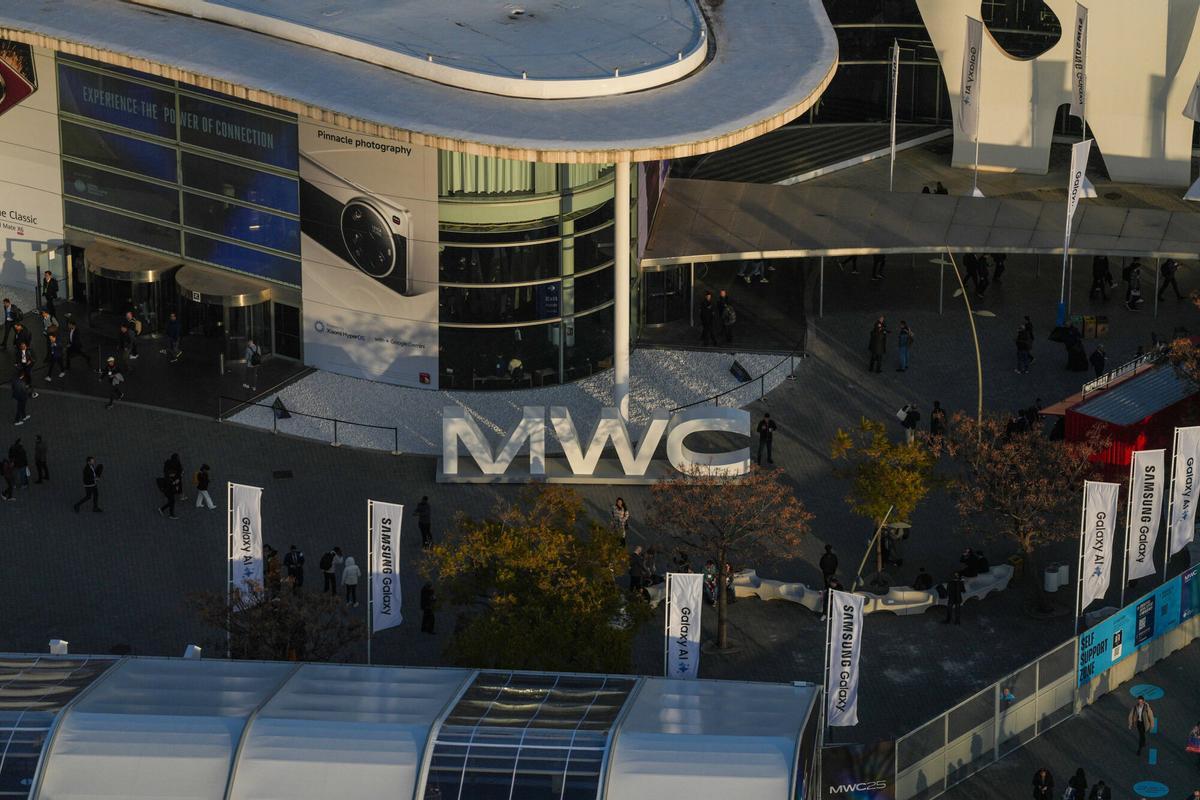
Barcelona hosted the twentieth edition of the congress under the theme The IQ Era, with 585 million euros of direct economic impact and an inauguration by King Felipe VI. What could have been read as a routine industry event turned into a collective declaration of intent: AI processing is migrating from the data center to the device chip, and manufacturers who don't have that piece ready by 2027 are going to have a visible problem.
That's the headline. Now for the detail that matters.
Why mobile manufacturers stopped talking about the cloud
Honor was the company that put the most concrete data on the table: a processor designed to operate within the thermal and space constraints of next-generation foldable phones, without sacrificing computing capacity. The company presented it as the world's smallest processor for consumer devices, a claim still awaiting independent validation but pointing to a miniaturization race the industry has been postponing for years.
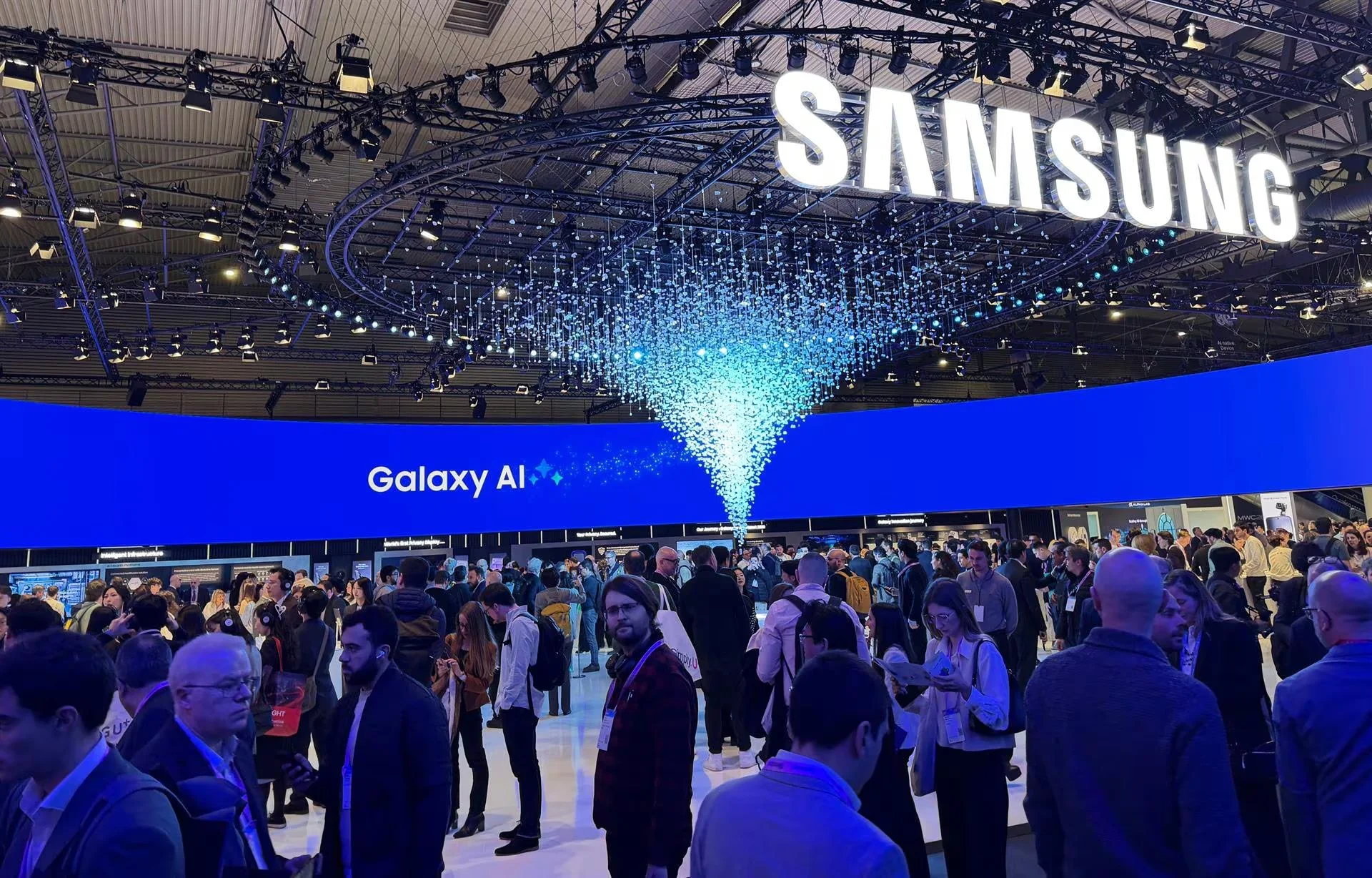
Samsung arrived with more muscle and a product in the final stretch: the Galaxy S26 family, equipped with proactive artificial intelligence architectures. The system learns from the user's biometric and usage patterns in encrypted form, runs complex calculations on the device itself, and makes decisions in fractions of a second. Without consulting the cloud. Without network latency. Without leaving a trace on an external server.
Privacy as a selling argument is old. Privacy as a technical architecture is a different conversation.
The shift isn't merely aesthetic. When AI lives in the chip, the phone works in a subway tunnel, in a zone with no coverage, and during a power outage. Autonomy stops being a marketing promise and becomes a measurable technical specification.
Starlink wants every phone to be its own antenna
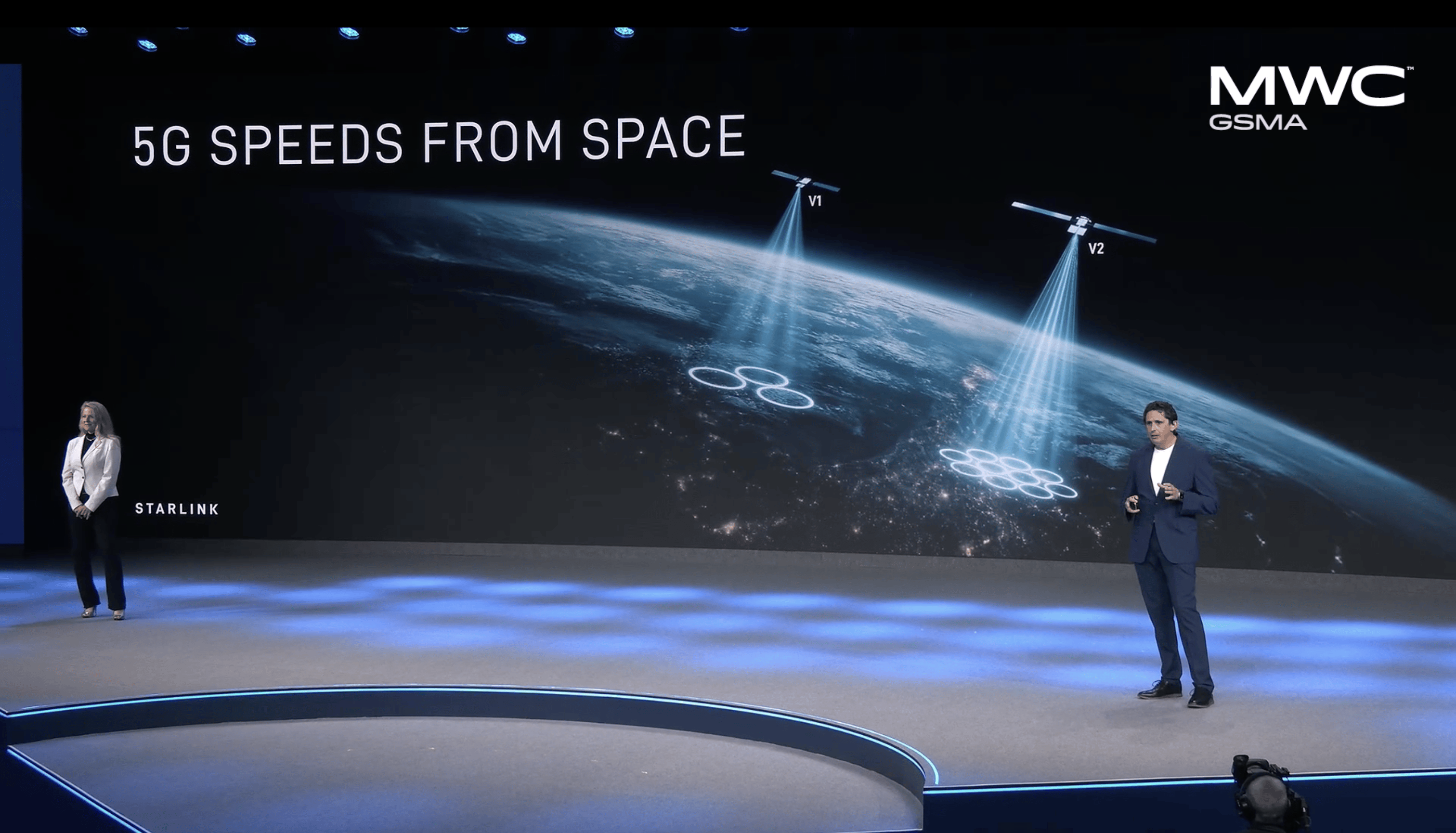
The other story of MWC 2026 came from the SpaceX stage. Gwynne Shotwell and Michael Nicolls presented the next phase of Starlink Mobile with a figure worth reading twice: the second generation of satellites with Direct-to-Cell technology will offer link performance 20 times higher and data transmission density roughly 100 times greater than their predecessors.
The system requires no intermediate antennas. Any conventional smartphone will be able to connect to space without terrestrial infrastructure, at a quality comparable to current 5G networks. SpaceX projects reaching 25 million connected users before the end of 2026, deploying the constellations aboard Starship.
It's an ambitious figure. It's also the first time satellite coverage stops being a niche solution for expeditions or emergencies and aspires to compete with terrestrial operators on price and accessibility.
The most immediate impact isn't the tourist without roaming. It's the farmer in a zone with no infrastructure, the journalist in a region with active censorship, the field hospital in an armed conflict. Direct-to-Cell technology turns those exceptional scenarios into ordinary use cases.
There's an underlying irony in SpaceX, a private company, building the emergency connectivity infrastructure that states have been promising for decades with fiber optic cables.
Energy and ethics: the debate nobody closed in Barcelona
The congress wasn't all trade-show optimism. King Felipe VI opened the forum by pointing to the urgency of balancing AI's energy appetite with climate commitments, and algorithmic ethics occupied entire panels across the three days.
The figure is not trivial: training a large language model consumes as much energy as hundreds of homes in a year. Moving that processing to the device reduces the load on data centers, but doesn't eliminate the chip manufacturing problem or that of the critical mineral extraction those processors require.
The industry talked about sustainability. The industry also unveiled more hardware.
We're still waiting for the congress where both conversations happen in the same room, with the same weight, and without one serving as an alibi for the other.
Robots, holograms, and the inventory of what still has no launch date
MWC 2026 dedicated considerable space to three categories with functional prototypes that this year were not just renders: humanoid robots for industrial and domestic use, enhanced virtual reality platforms, and holographic 3D displays that require no peripheral lenses.
None have a confirmed mass-launch date. All three have video demonstrations circulating on social media since Monday.
Historically, the gap between a trade-show prototype and a market product is between two and five years. Sometimes more. But the direction is set: the hardware of 2026 assumes the user wants a layer of information superimposed on physical reality, without cables, without intermediate apps, and without an instruction manual.
What remains pending
MWC 2026 built consensus on something few industries manage to achieve: the processing paradigm is changing in a structural way, not a cyclical one. On-device AI is not a cycle trend; it's the answer to a latency, privacy, and resilience problem that cloud servers never fully resolved.
What wasn't made clear is who pays for the transition. The new processors are costly. SpaceX's satellites operate under a subscription model that still has no public price for the mass Direct-to-Cell segment. And the debates on digital sovereignty that dominated the panels produced no regulation. Only declarations.
King Felipe VI opened the congress. The contracts were signed by others.
Sources
The most important news while you enjoy a cup of coffee.
Join our community. Get our exclusive weekly analysis before anyone else.
Related News

TecnologíaGlobal
5 min read
NASA confirms the date and menu for Artemis II
The Orion spacecraft has no refrigerator or resupply. That's why NASA designed 189 unique items, amaranth as protein, five types of hot sauce, and 43 cups of coffee for 10 days around the Moon.

TecnologíaDinero
5 min read
Meta lays off 16,000 people. Its stock rises 3%
Reuters confirmed plans to cut up to 20% of Meta's workforce. Wall Street celebrated the news with a 3% surge. In 2026, AI already justifies 55,775 layoffs in the tech sector.

Tecnología
6 min read
AI already solves centuries-old math. What your bank encrypts is being rebuilt from scratch.
AlphaEvolve surpassed any known human solution in 20% of 67 open mathematical problems. At the same time, the RSA encryption that protects banks and government networks has been in the process of replacement for months. Two converging transformations.


