On March 17, 2026, Donald Trump's brief and aggressive attempt to assemble an international coalition to patrol the Strait of Hormuz ended in disappointment, prompting the president to lash out at the European nations that rejected his demands for support in his war against Iran. What followed was not a diplomatic disagreement. It was the slow-motion collapse of a security architecture built after World War II.
France, Germany, Spain, Italy, the Netherlands and Greece all ruled out any military involvement in the area, arguing it was not their war. The message was unanimous and, in institutional terms, devastating.
Why Europe said no: Article 5 does not apply here
The technical distinction is simple but decisive. NATO is a defensive alliance and does not compel its members to participate in offensive operations. The principle of collective defense — Article 5 — has only been invoked once, after the September 11 attacks. The operation against Iran does not fall within the scope of collective defense; it is an action driven unilaterally by the United States and Israel.
In other words: Trump started a war without consulting his allies and then asked them to defend it as if it were everyone's. Germany was particularly blunt: it stressed that the conflict had not been consulted with allies and that, therefore, it was not NATO's place to intervene.
German Defense Minister Boris Pistorius summed it up in a line now circulating in every foreign ministry: "This is not our war; we did not start it."
Spain went beyond the legal argument. Defense Minister Margarita Robles ruled out any involvement: "Spain is not considering any mission in Hormuz. What we are calling for is the demand that the war end."
Trump's response: first he asked for help, then said he never wanted it
The sequence has a peculiar internal logic. The day before the European rejection, Trump had claimed he had heard from "numerous" countries whose ships were "on their way." The next day he was declaring that most NATO nations had not stepped up.
His public reaction was predictable in substance and surprising in form. In a post on Truth Social, Trump stated: "Most of our NATO 'allies' have informed us that they don't want to be involved in our military operation against the terrorist regime of Iran. Given the fact that we have been so militarily successful, we no longer 'need' nor want the help of NATO countries: We never needed it!"
Trump called NATO a "paper tiger" and vowed to remember the cowardice of his allies. He also suggested Washington should reconsider its NATO membership, though he clarified that he had nothing concrete in mind for the moment.
Nobody in Brussels fully believed him. Nobody dismissed it entirely either.
The energy context that makes everything more urgent
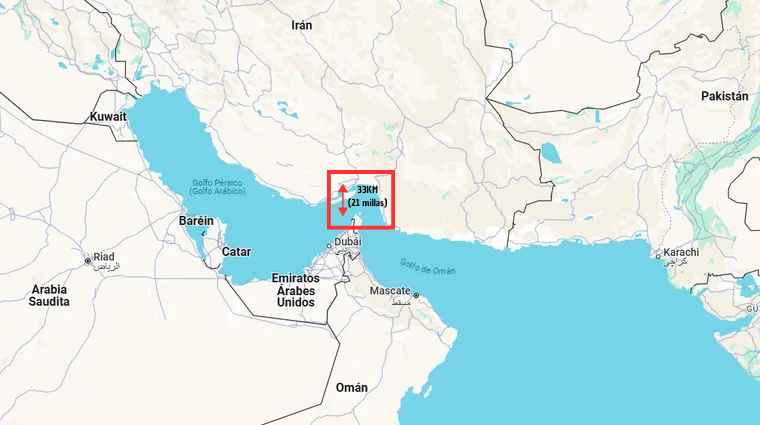
The Iranian blockade of the Strait of Hormuz is not rhetoric. Trump had asked several countries to help patrol the strait — through which 20% of the world's oil passes — after Iran responded to Washington and Tel Aviv's strikes by using drones, missiles and mines to close the passage to oil tankers.
The economic consequences are immediate. Brent crude surpassed $111 per barrel. Natural gas saw an intraday spike of 17%. And behind those numbers lies something more concrete: natural gas is a fundamental input in producing nitrogen fertilizers, which directly links the military conflict to the global food supply chain.
For analyst Francesco Tucci, professor of International Relations at the Universidad Peruana de Ciencias Aplicadas, the allies' rejection not only limits Washington's room to maneuver but exposes a structural fracture within the Atlantic alliance.
A fracture that did not begin on March 17. It simply became impossible to ignore.
What Macron is proposing — and what no one has accepted yet
Europe is not paralyzed. It is, more precisely, divided between the urgency of protecting its energy routes and the fear that any military move will be interpreted as a declaration of war.
Macron is considering, in the medium term, a maritime escort mission — but only contingent on a scenario without active hostilities and with broad political backing. The EU explored the possibility of modifying the Aspides naval operation to reopen the strait, but several countries opposed it. NATO Secretary General Mark Rutte is counting on a short-term reopening of the passage, though without committing European troops in the process.
It is the most comfortable position available: wait for the problem to solve itself and then declare you were always in agreement with the solution.
Three possible scenarios for the weeks ahead
The current landscape opens very different paths. Without NATO backing, the United States could opt for more unilateral action — air and naval strikes against Iranian capabilities in the area — or attempt to build an ad hoc coalition outside the Alliance, though with uncertain support.
The second path is covert negotiation. A possible exit channel could involve China, in a scenario where none of the parties has clear incentives to prolong the war. While Iran seeks to project resistance without ceding internal power, it is also facing damage to its military infrastructure; the United States, for its part, is grappling with economic fallout and international pressure.
The third path is the most uncomfortable to name: that the conflict stabilizes without being resolved, with the strait semi-blocked, energy prices permanently elevated and NATO reduced to an alliance that only functions when all its members agree on who the enemy is.
That third path has no official name. But it is the one that most closely resembles the present.
What Article 5 could never have anticipated
The only time NATO invoked Article 5 was after September 11 — precisely in direct support of the United States. Europe mobilized troops to defend Washington. Twenty-five years later, Washington started a war without consulting Europe and then demanded that Europe back it by invoking the very same principle.
The geometry is perfect. The outcome, foreseeable.
UK Prime Minister Keir Starmer was explicit at a press conference: "Let me be clear: that will not be — and has never been conceived as — a NATO mission." Trump responded with sarcasm: "Keir is no Churchill."
Churchill, at least, had allies when he needed them.
What remains now is not exactly a rupture. It is something more diffuse and more difficult to repair: the public evidence, recorded in minutes and communiqués, that the Atlantic alliance only works when interests align. And that when they do not, each side declares it always knew that was the case.
The Strait of Hormuz will remain closed or semi-open for as long as the conflict lasts. Oil prices will stay elevated. And somewhere in a Brussels office building, someone will be drafting the communiqué explaining why NATO is still relevant.
They will have a lot of work to do.