Culture•2 min read
Berlinale 2026 Bets on Political Cinema and New Voices: A Program Challenging Spectacle

Berlinale 2026: Auteur Cinema, Politics, and New Voices on the International Stage
The 76th edition of the Berlin International Film Festival emerges with a clear intention: to prioritize auteur cinema and films that interrogate the political. The program, released on February 11, includes 22 titles in competition where only a third feature high-profile stars; the rest bet on risky proposals, local narratives, and perspectives that seek conflict and questioning rather than comfort and easy entertainment. The opening film is No Good Men by Shahrbanoo Sadat, a story set in 2021 Kabul that focuses on the lives and rights of women following the US military withdrawal.
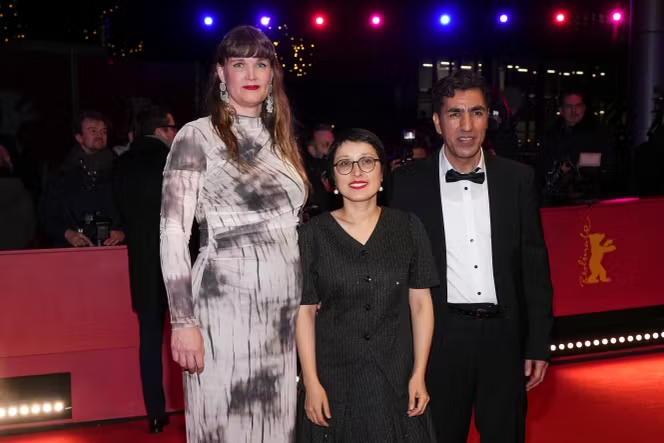
The Berlinale confirms its DNA once again: it is not a box office fair but a forum for debate. Directors from diverse contexts, Chad, Palestine, Afghanistan, and Latin America,add films seeking to explore migration, dictatorships, and historical memory. Examples that stand out in the selection are Soumsoum, the Night of the Stars (Chad) and the Palestinian co-production In a Whisper, titles that, on paper, prioritize social urgency and committed authorship.
The festival also presents itself as a platform for emerging directors and marginalized voices; the decision to program films without stars confirms a bet on content that challenges and provokes. For the industry, the Berlinale remains a critical showcase: buyers, curators, and sister festivals observe the creative pulse that filters trends and new names that will later feed global auteur circuits.
There are industrial and aesthetic reasons for this choice. Aesthetically, political cinema feeds public debates at a moment when migration issues, conflict, and memory are urgent in Europe. Industrially, the Berlinale offers a market and visibility for projects that, without commercial glitter, need allies to finance international distribution.
Practical questions remain: Will these films be improved commercially beyond festivals? Will they achieve resonance on platforms that reproduce massive spectacles? The answer will be hybrid: some films will find global niches and academic circuits; others will remain in the festival orbit. What is certain is that Berlin bets on cinema that demands attention.
The most important news while you enjoy a cup of coffee.
Join our community. Get our exclusive weekly analysis before anyone else.
Related News

Cultura
7 min read
86 years old, it was the 'final level' of Chuck Norris: Farewell to the action cinema legend
The actor, world karate champion and internet phenomenon passed away on March 19 after a medical emergency in Kauai. His last post was a video training on his birthday.

GlobalCultura
6 min read
World Water Day 2026: women and 200 million hours of water inequality
Every day, women and girls worldwide spend the equivalent of 23,000 human years carrying water. World Water Day 2026 repeats it. The question is how many more times it needs to be said.

Cultura
6 min read
Sinners arrived with 16 nominations. Paul Thomas Anderson left with the statuette.
Anderson won with only his second Best Picture to history. Jordan took Best Actor. Buckley shocked with Hamnet. And Frankenstein quietly dominated the technical awards. The 98th edition didn't leave a single comfortable winner.


