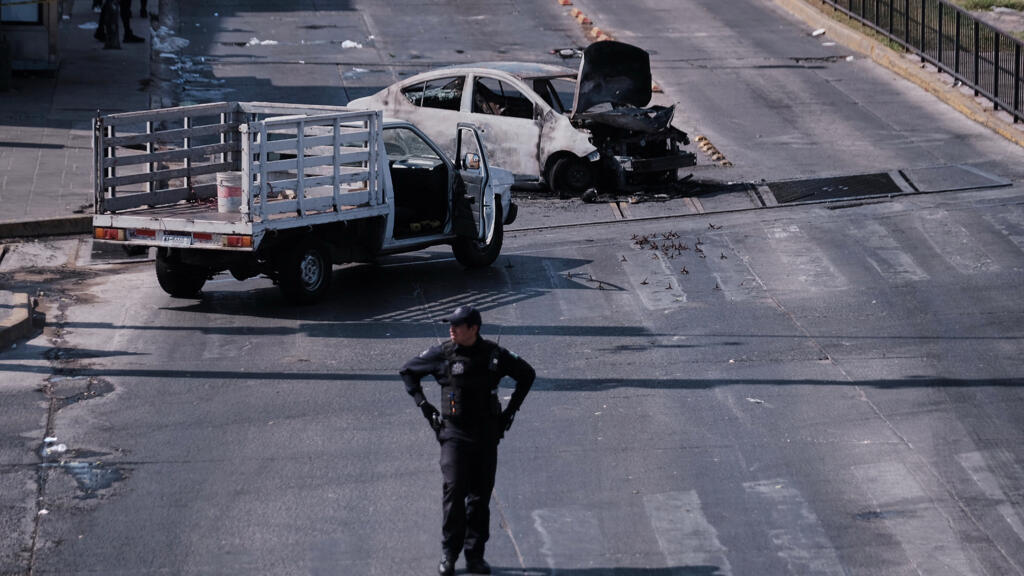
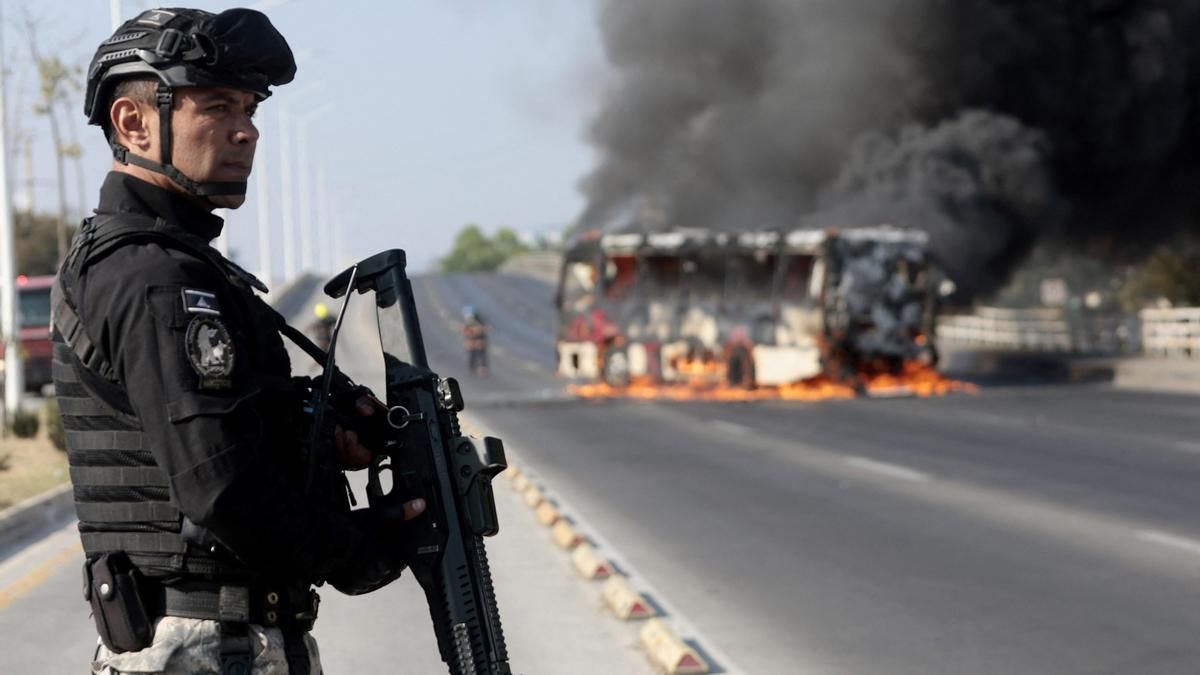
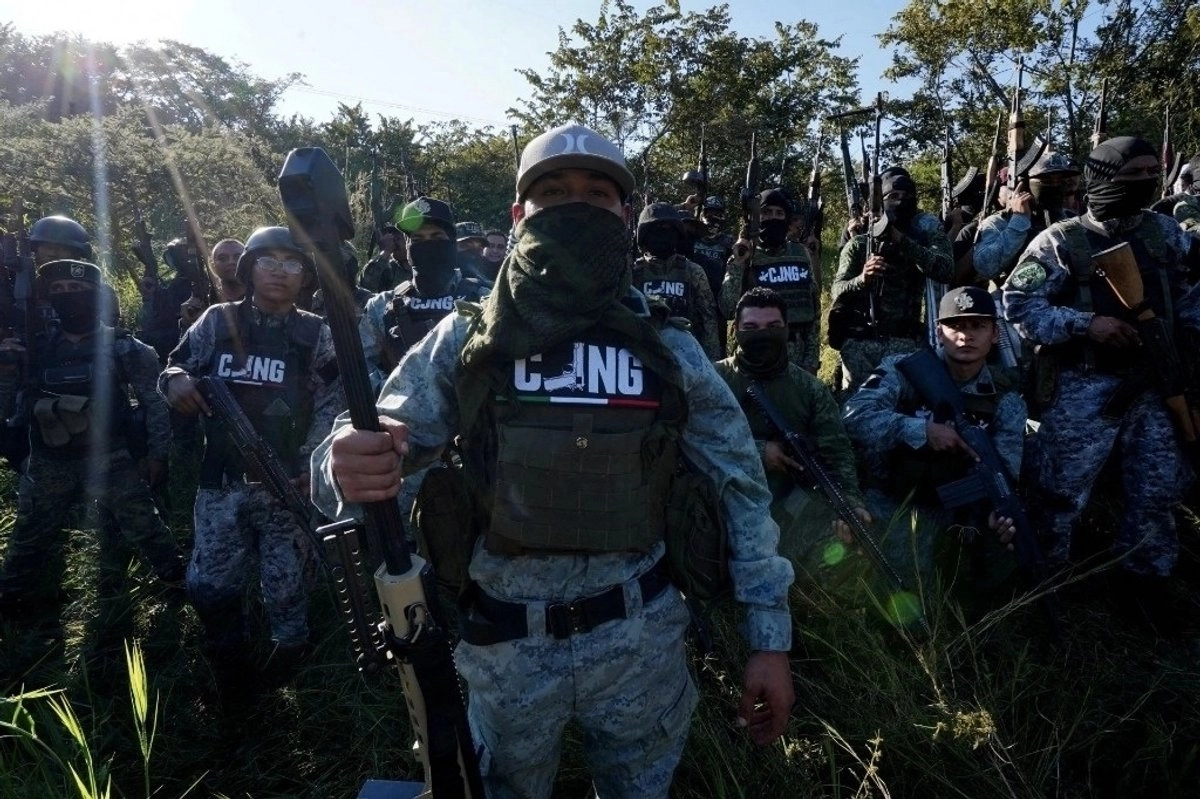
The Miguel Hidalgo y Costilla International Airport became a scene of widespread panic this Sunday, February 22, after armed individuals were reported inside and around the air terminal. The events are directly related to the death of Nemesio Oseguera Cervantes, alias "El Mencho," leader of the Jalisco New Generation Cartel (CJNG), who was killed during a federal operation in the municipality of Tapalpa. The cartel's response was swift: highway blockades, burning vehicles, armed clashes, and a show of force that has placed Jalisco under a Code Red security alert.
Videos circulating on social media show what is now a routine in Mexico every time a major drug lord falls: passengers running through the terminal corridors, abandoned luggage in the midst of the chaos, families throwing themselves to the ground seeking refuge, and the unmistakable sound of collective fear when nobody knows if the gunshots are near or far. Airport authorities insist that the terminal "operates normally," an official euphemism that anyone who has seen the videos knows is a technical lie. Yes, planes take off and land. But normality died the moment passengers had to decide whether to run to the exits or hide in the bathrooms.
The operation that killed El Mencho: Tapalpa as the final stage
The Secretariat of National Defense (SEDENA) confirmed that Nemesio Oseguera Cervantes was killed during a joint operation with the Navy and the National Guard on the outskirts of Tapalpa, a mountainous municipality in Jalisco known more for its rural tourism than for being a refuge for drug traffickers. According to the official statement, federal forces acted based on intelligence that located the CJNG leader in a fortified rural property. The confrontation lasted approximately two hours and left an official toll of 11 dead, including El Mencho.
The death of Oseguera Cervantes closes a chapter of nearly two decades of extreme violence in Mexico. The CJNG, under his leadership, became the most powerful and expansive cartel in the country, with presence in at least 28 of the 32 Mexican states and documented operations in the United States, Europe, and Asia. Its specialty was calculated brutality: videos of beheadings, attacks with armed drones, ambushes against military personnel, and a logistical capacity that made other criminal groups look amateur. The US State Department offered a 10 million dollar reward for information leading to his capture. Now that money remains unclaimed because a Mexican operation eliminated him first.
The CJNG's response: coordinated violence throughout Jalisco
The cartel's reaction was immediate and coordinated, following the manual that Mexican criminal groups execute every time they lose a leader: proving they are still dangerous even if headless. Blocks of burning vehicles cut off the main highways connecting Guadalajara with other cities. The highway to Colima became impassable. The toll-free road to Chapala was blocked with burning cargo trucks. Access to the airport from the metropolitan area became a labyrinth of alternative routes while drivers tried to dodge the hot spots.
Reports of violence were not limited to ground transportation. Several commercial establishments in the Guadalajara metropolitan area were attacked with grenades and long-arm fire. In Tlajomulco de Zúñiga, a conurbated municipality, hitmen burned down an entire gas station after evacuating employees and customers. In Zapopan, armed men fired at a municipal police station, wounding two officers. The strategy was clear: saturate the authorities' response with multiple simultaneous incidents to hinder coordination and maximize chaos.
Airport under siege: panic among passengers and operational adjustments
The incidents inside the airport began around 2:00 PM when reports of armed people circulating near the south terminal generated the first alarms. Eyewitnesses described how private security groups at the airport began moving quickly, closing entrances, and evacuating specific areas. Passengers, initially confused, panicked when they heard shouts of "To the ground, to the ground!" coming from security personnel. In a matter of minutes, social networks were flooded with videos recorded from the phones of terrified travelers.
In videos shared on social networks, the chaos experienced at the Guadalajara airport can be seen.
The Pacific Airport Group (GAP), operator of the terminal, issued an official statement noting that "preventive security protocols were activated in coordination with federal and state authorities" and that "air operations continued without major interruptions." However, multiple airlines adjusted itineraries. Aeromexico canceled three flights scheduled for the afternoon. Volaris delayed departures to domestic destinations. VivaAerobus recommended passengers arrive three hours early due to "extended security screenings."
Code Red and temporary militarization of Jalisco
The governor of Jalisco activated the state Code Red, a protocol that involves the massive deployment of security forces, temporary suspension of certain free transit guarantees, and direct coordination with federal authorities. The National Guard sent reinforcements to the entity. The Army deployed armored convoys at strategic points in the metropolitan area. Military helicopters flew over the city for hours, establishing an intimidating aerial presence that, rather than reassuring the population, reminded them that the rule of law is temporarily suspended while law enforcement tries to contain the cartel's reactive violence.
The Secretariat of Security and Citizen Protection issued a travel alert for US citizens in Jalisco, recommending they avoid non-essential travel and stay informed about the security situation. Several international consulates sent messages to their nationals warning about the volatility of the situation. Tourism in Guadalajara, which was just recovering from previous blows, received another devastating impact just before the high spring season.
The future of the CJNG: fragmentation or consolidation
The death of El Mencho opens multiple scenarios for the future of the CJNG. The first scenario is fragmentation: different lieutenants who operated semi-autonomous cells under the cartel's umbrella could declare independence and start internal territorial wars for control of lucrative plazas. This was the dynamic that followed the fall of leaders of other groups like Los Zetas or the Gulf Cartel, resulting in exponential violence while rival factions eliminated each other.
The second scenario is consolidation under a new strong leadership. The CJNG has a more sophisticated organizational structure than previous cartels. If a successor manages to impose authority quickly and maintain the loyalty of the operational cells, the cartel could continue operating with levels of effectiveness similar to those it had under El Mencho. Security analysts mention Rubén Oseguera González, alias "El Menchito" and son of El Mencho, as a possible successor, although he currently faces charges in the United States after being extradited in 2020.
The third scenario, the least likely but most desirable for Mexican authorities, is progressive dismantling through coordinated captures of middle managers that take advantage of the leadership vacuum. However, the history of the fight against drug trafficking in Mexico suggests that this optimistic scenario rarely materializes. Cartels are resilient organizations that adapt, mutate, and survive even when they lose their founders.
The reality nobody wants to admit
The death of El Mencho will be celebrated by Mexican and US authorities as a significant victory in the fight against organized crime. Official statements will speak of a "resounding blow" and the "dismantling of criminal structures." The reality is more somber: the CJNG will continue to exist under another name, with another leader, carrying out the same criminal operations that generated billions of dollars annually. Because as long as there is massive demand for drugs in the United States and endemic corruption in Mexican institutions, cartels simply replace their fallen and continue.
For the passengers trapped at the Guadalajara airport this Sunday, those geopolitical considerations were irrelevant. The only thing that mattered was making it out alive from an air terminal that temporarily became a war zone. Some made it. Others lost flights, connections, and any remaining illusion that Mexico is a country where you can travel without calculating the odds of getting caught in a crossfire.