Technology•5 min read
The new agentic era: AI that no longer waits for you to ask

Chatbots just became obsolete. Google deployed Gemini 3.1 and OpenAI launched GPT-5.2, marking the definitive transition toward "Agentic Systems" that reason, plan, and generate original knowledge without human supervision. The difference from previous generations is qualitative: these models don't merely retrieve existing information and rephrase it elegantly. They prove mathematical theorems, infer physical principles, and execute complex logical reasoning completely autonomously. GPT-5.2 solved theoretical physics problems that no human had formally demonstrated, generating new empirical knowledge. The academic world is in a panic.
The technological leap is brutal. GPT-4, launched in 2023, was basically a sophisticated statistical autocorrect predicting the next words in sequence based on patterns learned from the internet. GPT-5.2 possesses a recursive architecture allowing it to plan long-term tasks, divide them into subtasks, execute them sequentially, and auto-correct when it makes mistakes. It is the difference between a calculator and a mathematician. The first applies predefined algorithms. The second reasons about new problems and develops original approaches.
GPT-5.2 is closer to the mathematician.
The semiconductor war: NVIDIA vs AMD vs biocomputing
The deployment of these agentic models is intrinsically linked to geopolitical warfare for the control of specialized hardware. OpenAI is rebalancing its strategic alliances, shifting massive volumes of capital between NVIDIA and AMD to optimize computational efficiency. NVIDIA has dominated the AI GPU market for a decade, but its H100 and H200 chips are extraordinarily expensive and scarce due to US export restrictions to China. AMD offers a cheaper alternative with MI300X chips, albeit with slightly lower performance.
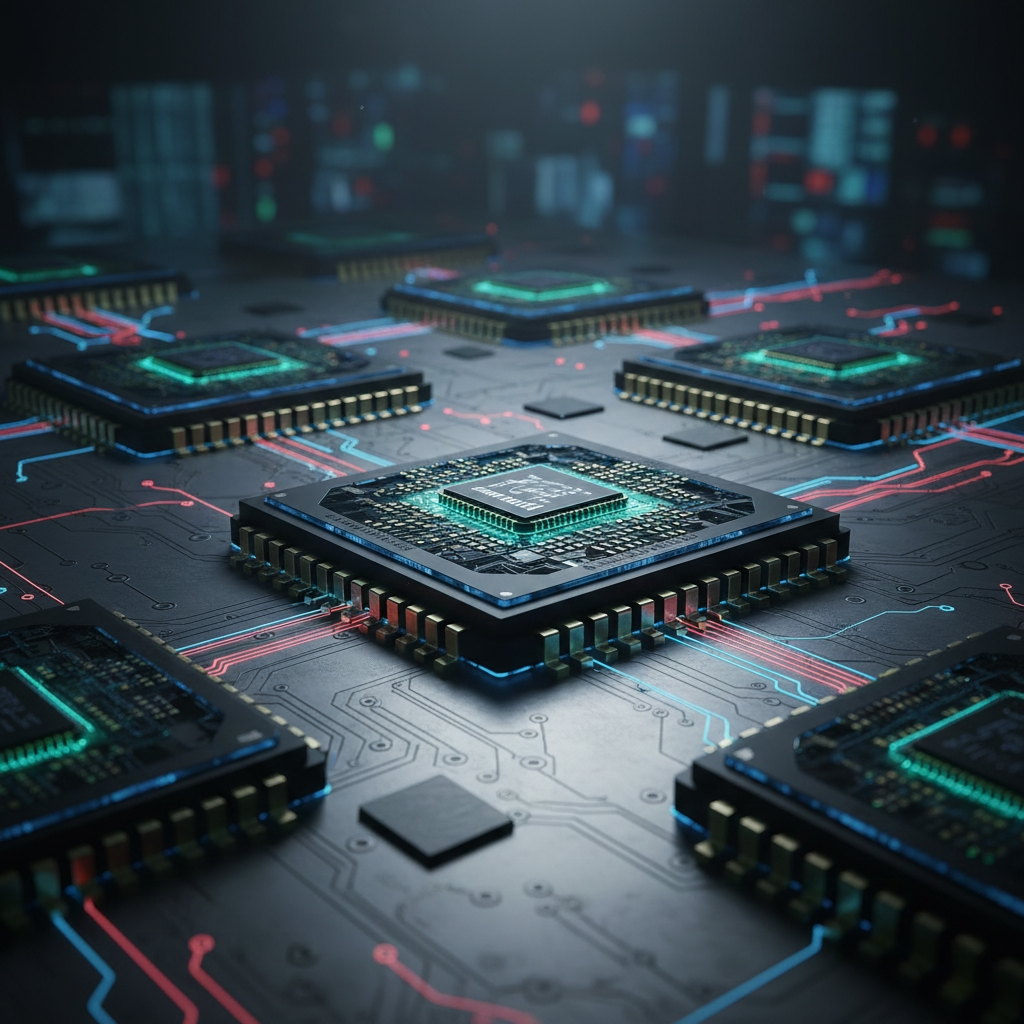
Google is taking a more radical route: biocomputing. Gemini 3 uses a hybrid architecture combining traditional silicon processors with synthetic biological components explicitly designed to replicate the energy efficiency of human neurons. The human brain consumes approximately 20 watts of energy; data centers training massive AI models consume megawatts. If Google succeeds in scaling biocomputing, it could reduce inference energy costs by orders of magnitude. But the technology is in an experimental stage and faces massive ethical obstacles: what does it mean to "kill" a biological processor when you decide to turn it off?
The Pentagon pressures Anthropic: inevitable military applications
The Pentagon's intervention over private laboratories like Anthropic (creators of Claude) confirms that the US government perfectly understands the dual-use implications of agentic systems. A model capable of autonomous reasoning, long-term planning, and generating original knowledge can design weapons systems, optimize military logistics, decipher encrypted communications, and coordinate tactical operations without human supervision. The Department of Defense cannot allow these capabilities to remain exclusively in private hands or, worse yet, to be accessible via open-source models.

The pressure on Anthropic is particularly significant because the company was founded by former OpenAI employees who abandoned the organization due to disagreements over AI safety. Anthropic positioned itself as a "more ethical" and "safer" alternative prioritizing alignment and control over development speed. But that posture becomes untenable when the Pentagon demands priority access to advanced models for national security applications. Anthropic faces an existential dilemma: maintain principles and lose relevance, or cooperate with the military-industrial complex and betray foundational values.
China destroys Silicon Valley's cultural monopoly
While OpenAI and Google fight for technological leadership, China is eroding the Western monopoly on content production through open-source models and hyper-realistic video generation tools. Platforms like Kuaishou and ByteDance (TikTok) have launched generative AI models that produce video quality comparable to OpenAI's Sora, but without geographic restrictions or algorithmic censorship imposed by Western values. Hollywood faces an existential threat: why hire actors, directors, and production crews if Chinese AI can generate complete movies from script to final render?
The cultural impact will be massive. For a decade, Silicon Valley dictated what content was produced, what narratives were amplified, and what values were promoted globally through the control of technology platforms. The democratization of production tools through open-source AI shatters that monopoly. Anyone with a decent laptop and access to Chinese models can produce short films, animated series, or documentaries without starting capital or approval from corporate gatekeepers. Hollywood won't survive this transition without a radical transformation of its business model.
The agentic future: utopia or dystopia depends on who controls the models
Agentic systems promise to solve problems humans cannot: global supply chain optimization, drug discovery, advanced materials design, and climate phenomena prediction. But they can also design biological weapons, coordinate massive disinformation campaigns, and automate totalitarian surveillance on a planetary scale. The difference between utopia and dystopia will depend exclusively on who controls these systems and for what purposes they are deployed.
GPT-5.2 and Gemini 3 mark a point of no return. Artificial intelligence transitioned from a passive tool to an autonomous agent capable of generating original knowledge. Humanity just created entities that reason better than us in specific domains. And nobody really knows what happens when those entities reach general reasoning capabilities. February 2026 will be remembered as the month we crossed that threshold without being prepared for the consequences.
Sources
The most important news while you enjoy a cup of coffee.
Join our community. Get our exclusive weekly analysis before anyone else.
Related News

TecnologíaGlobal
5 min read
NASA confirms the date and menu for Artemis II
The Orion spacecraft has no refrigerator or resupply. That's why NASA designed 189 unique items, amaranth as protein, five types of hot sauce, and 43 cups of coffee for 10 days around the Moon.

TecnologíaDinero
5 min read
Meta lays off 16,000 people. Its stock rises 3%
Reuters confirmed plans to cut up to 20% of Meta's workforce. Wall Street celebrated the news with a 3% surge. In 2026, AI already justifies 55,775 layoffs in the tech sector.

Tecnología
6 min read
AI already solves centuries-old math. What your bank encrypts is being rebuilt from scratch.
AlphaEvolve surpassed any known human solution in 20% of 67 open mathematical problems. At the same time, the RSA encryption that protects banks and government networks has been in the process of replacement for months. Two converging transformations.


