Donald Trump signed the executive order his trade advisers had spent months preparing and the rest of the world had been dreading: a 15% tariff on all imports entering the United States, with no initial exceptions, no grace periods, and none of the commercial diplomacy that kept the global system functioning for decades. The measure, grounded in Section 122 of the Trade Act of 1974 and deliberately evoking the historic Hawley-Smoot Act of 1930 that deepened the Great Depression, represents the greatest challenge to international trade since the creation of the World Trade Organization in 1995.
The White House's official justification is predictable: protect the national manufacturing base, correct chronic trade imbalances, defend American jobs. The reality is that Trump is fulfilling campaign promises that sounded good at rallies but that economists across the political spectrum warned would unleash chaos. And they have just been proven right. Global financial markets collapsed immediately. The Dow Jones fell 1,247 points in the first three hours of trading. The S&P 500 lost 3.8%. Asian stock exchanges that opened after the announcement plummeted. Europe panicked. And the United States' trading partners began preparing retaliations that will turn this decision into the most destructive trade war since World War II.
Hawley-Smoot 2.0: When History Repeats Itself as Tragedy
The reference to the Hawley-Smoot Act of 1930 is neither accidental nor innocent. That legislation, passed by the U.S. Congress in the depths of the economic depression, imposed massive tariffs on more than 20,000 imported products under the argument of protecting domestic jobs. The result was catastrophic: trading partners responded with their own tariffs, global trade collapsed by approximately 66% over four years, and the economic depression the tariffs were supposed to mitigate deepened brutally. A thousand economists signed a letter urging President Herbert Hoover to veto the bill. Hoover signed it anyway. History judged it as one of the worst economic policy mistakes of the 20th century.
Trump is repeating that mistake with full knowledge of the consequences. His trade advisers, led by Peter Navarro (who returned to the administration after serving a prison sentence for contempt of Congress), have argued for years that tariffs are a legitimate tool to rebalance the American economy. Navarro wrote multiple books defending aggressive protectionism. Now he has executive power to implement his theories. And the rest of the world will pay the price of that ideological experiment.
Section 122: a Constitutional Blank Check for Trade War
The executive order is grounded in Section 122 of the Trade Act of 1974, a rarely used legal provision that grants the president unilateral authority to impose tariffs in economic emergency situations. The definition of "economic emergency" is deliberately vague, allowing broad interpretations. Trump argues that the United States trade deficit, approximately $773 billion in 2025, constitutes a national emergency that justifies immediate action without congressional approval.
The legality of the order will inevitably be challenged in federal courts. But that process will take months or years, and in the meantime the 15% tariff will be in effect, distorting global trade, raising prices for American consumers, and provoking retaliation from virtually all of the United States' major trading partners. China has already announced reciprocal 20% tariffs on all American imports. The European Union called an emergency meeting to coordinate its response. Japan issued a formal protest. South Korea called its ambassador in Washington in for consultations.
Mexico: Sheinbaum Defends Sovereignty, Ebrard Negotiates Exemptions
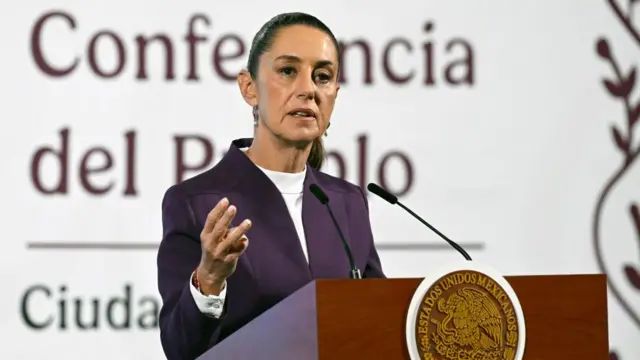
The Mexican reaction was immediate and coordinated. President Claudia Sheinbaum issued a statement defending national sovereignty and reminding that Mexico will not accept unilateral impositions that violate existing trade treaties. Economy Secretary Marcelo Ebrard announced urgent talks in Washington to secure that 85% of Mexican exports, protected by the United States-Mexico-Canada Agreement (USMCA), remain exempt from the 15% tariff.
Mexico's position is legally solid but politically complicated. The USMCA, which Trump himself negotiated and signed during his first presidential term, explicitly establishes tariff-free trade among the three North American countries. Imposing a 15% tariff on Mexican imports directly violates that treaty. But Trump has repeatedly demonstrated that international treaties are documents he respects only when convenient. If he decides to ignore the USMCA, Mexico would have to take the issue to dispute resolution panels that would take years to issue rulings, with no guarantee that the United States would comply with those rulings.
Ebrard is betting on direct negotiation to avoid that scenario. His argument is pragmatic: Mexico has been the United States' top trading partner since 2023, surpassing China and Canada. Mexican exports, especially in automotive, electronics, and agriculture, are essential components of American supply chains. Imposing 15% tariffs on those exports will raise costs for American manufacturers, make products more expensive for American consumers, and potentially eliminate American jobs in industries that depend on Mexican inputs.
The Economic Impact: American Consumers Will Foot the Bill
The economic analysis of this measure is unanimous: American consumers will absorb most of the cost of the 15% tariff. Tariffs are not paid by the exporting countries, as Trump repeatedly claims. They are paid by American importers, who transfer that cost to consumers through higher prices. A 15% tariff on all imports means that virtually everything sold in the United States will become 15% more expensive, from electronics to clothing, from cars to food.
The Tax Foundation estimates that the tariff will reduce U.S. GDP by approximately $250 billion annually and eliminate around 500,000 jobs. The Peterson Institute for International Economics projects that the disposable income of the average American household will fall by approximately $1,700 per year. And those calculations assume other countries do not respond with reciprocal tariffs. When China, the European Union, Japan, and other trading partners impose their own tariffs on American exports, the economic damage will multiply exponentially.
The Post-Tariff World: Fragmentation of the Global Trade Order
Trump's decision marks the effective end of the multilateral trade order the United States led for 75 years. After World War II, the United States built a rules-based trading system of multilateral treaties and peaceful dispute resolution. The General Agreement on Tariffs and Trade (GATT), replaced by the WTO in 1995, created a framework where countries gradually reduced trade barriers through coordinated negotiations.
Trump has just blown up that system. If the president of the United States can unilaterally impose 15% tariffs on all imports while ignoring existing treaties, then treaties mean nothing. If the American executive branch can invoke vague "economic emergencies" to justify extreme protectionism, then there are no rules limiting future actions. Other countries will take note and act accordingly: they will ignore treaties when convenient, impose their own arbitrary trade barriers, and seek trade alliances that exclude the United States.
China is already aggressively negotiating trade agreements with countries across Asia, Africa, and Latin America, offering access to its massive market without the political conditions the United States historically imposed. The European Union is accelerating free trade negotiations with Mercosur, India, and African nations. The world is reorganizing commercially, and the United States is voluntarily isolating itself from the system it created and from which it was the greatest beneficiary for decades.
February 23, 2026 will be remembered as the day commercial globalization officially died. Trump signed the executive order. The rest of the world will pay the consequences for years.